Who is Really Saving Us, or False Centering of Individuals

Imagine a scenario where a careless driver hits a young man riding a bicycle, causing him life-threatening injuries. A nearby witness quickly calls 911, a pair of paramedics arrive to stabilize the man, then immediately rush him to a hospital, where a talented doctor expertly repairs the damage, and starts him on the road to recovery.

My question to you is, who saved the young man? Was it the witness who called 911, the paramedics who got him safely to the hospital, or was it the surgeon? All of these people might have a claim to being a hero, but did any of them individually save him?

I would claim that the one who saved the young man was not an individual, but the society in which he lived. After all it was the society that created the 911 call system (plus wireless telephony for the call to be made). This same society also trained and paid for paramedics, evolving their job over the years into a highly effective medical intervention. The society is also responsible for having trained doctors at the hospital (for which it paid) not to mention staffing that hospital with all kinds of workers and specialists, who collectively developed a complex series of medical procedures, all to create an environment in which a terribly injured young man might be quickly and effectively healed. 

This may be the most logical answer to the question of who saved the young man, but it is admittedly a very awkward one. Humans do not tell stories like this. We like to center individuals in our stories, even if that centering is entirely without logic or reason. We like to say things like, “the President is responsible for the economy,” which is absolutely untrue, because it makes for a quick and dirty logical argument. Even then, if centering an individual into a place that they absolutely do not belong is somehow too unrealistic (a very high bar) then we will happily substitute that individual with a group of people. But then will conveniently speak of that group as if they were working in lock-step, exactly like an individual, even though we know this to also be impossible (that darn Congress better act soon). Hell, I can’t hardly get two friends to pick a time and date to watch a movie, and yet someone thinks that every Congressman (or every Jew, or every Conservative, or every Black person, etc) will somehow all magically work perfectly together? Have you been around people before?

The worst part of all of this “false centering” of individuals—sticking a person into the middle of a story where they really do not belong—is that it allows us to completely ignore all the social underpinnings that witnesses, paramedics, or even talented doctors rely upon to function. That is, it covers the truth. After all, none of these people (witnesses, paramedics, doctors, cops, etc.) are going to do anything heroic if the power is out, or if they are at the point of starvation, or cannot get to work because the roads need repair. In a complex society like ours, we constantly rely upon others to do our work, regardless of how heroic it might seem. Crazy as it sounds, doctors cannot do their work without real estate developers and plumbers. None of us can.

So why do we do this? Why do we make heroes out of ordinary people? Why are some people given the assumption of being heroic, and others not? It’s pretty weird when you think about it. Why do we center individuals in this way?

And why do we so happily ignore all the trappings of the larger society that supports us?

In reality, the only individual in the above scenario whose direct actions actually “caused” the young man to be saved is the careless driver. They are the only ones who had both the agency, and effect, that didn’t require support from others. But centering the potential villain in the story as a hero is just plain silly. Of course the driver is not the cause of the young man’s healing, but this does a good job of illustrating our rather insane need to order the events in our lives into some kind of narrative. 

Our culture is full of weirdness.

We Don’t Do Reality Very Well

As I type this there is an ongoing search for an 84 year old woman named Nancy Guthrie, who was kidnapped from her home on the morning of February 1st. Today (Feb. 22) marks the beginning of the fourth week that she has been missing. The story has captured a lot of media attention, and millions are praying for her swift discovery. Local law enforcement agencies, and the FBI, have gone to heroic efforts to retrieve her, so far to no success. If you talk to people on the street about this it seems like everyone had a theory. Almost all of them believe that Nancy Guthrie is still alive, and will remain so as long as someone acts swiftly enough, though who that “someone” is might vary from person to person.

Everyone seems to have this aching sense that we just need to find one more thing, one more clue, and Nancy will be home safe. We also understand that there is a ticking clock to this story. She is 84, and was taken without her medication. If she is not found soon there is a good chance she will perish from lack of medical care. 

What I don’t understand is why this story is so important? Why do we care? Why does everyone seem to have a theory about where Nancy is? We don’t know her, and almost none of us have any connection to her. Not that I wish ill on Mrs. Guthrie, or her family, but 84 year old women die every day in America, most without comment or concern. Why is this particular old woman important, and the others not?

The answer I keep coming back to is that we have a head full of stories, and feel a strong urge to see them concluded, in the right way. 

Good must overcome evil. The innocent must be saved, the guilty must be vanquished. That’s how this works. We all have a sense that this is the proper order of things. We all understand that an old and frail woman deserves to be found and returned safely. We all know that the people who kidnapped her deserve to be caught and punished. That is how all good stories are supposed to end.

 When stories do not end properly, like when an old woman is kidnapped and not swiftly returned, it makes us feel uncomfortable. This is not a small thing either. It feels as if something is wrong with our world. Her loss is somehow existential to us. Millions will pray for her recovery, so they can feel better about the world.

And that’s kind of weird to me. Not that I don’t feel these same things (because I do), but that I feel this way about someone I have no connection to. It’s as if the story has co-opted a small part of my brain and won’t let it go.

And I don’t understand why.

***

Stories, it turns out, are deeply important to humans. They exist in every person and in every culture. It doesn’t matter where you are from or what language you speak; the first thing you will learn, and likely the last thing you will speak of, are stories. 

Nowhere is the primacy of stories more evident than in our libraries. Libraries in America are divided into two sections: Fiction and Nonfiction. I find it telling that in the English language we don’t have a word for stories that are true. Instead we stuck with this weird compound word that means “things that aren’t stories.” It is as if all of human knowledge can be measured by whether it is a story, or not a story. Truth and fact, play a distant second. 

When I was in university in the mid 80s, I took a few Greek classes. There I learned that the Greek word for story is istoria (Ιστορία), pronounced ee-sto-REE-ah. Like a lot of words that start with a vowel, in Greek it is common to speak the word by aspirating before the vowel  (adding a soft “h” sound, like the beginning of the word heel). Thus istoria when spoken becomes historia. That word should look really familiar since this is the word we use for history. History is supposed to signify “true events”, but I think it’s important to remember that at its root, history is stories. Nothing more and nothing less. 

Not only are stories important to our culture, we use them personally all the time. Ask a friend how their day was, and they will likely tell you a story. Ask a co-worker about their meeting, or their commute, or their lunch, and you will likely get another story.

We don’t just get in a car and drive to work. We face adversity: “A truck pulled out in front of me, and when I honked my horn the driver gave me the finger!”

We don’t just have meetings, we have political battles: “Bill from Marketing grabbed my team’s artwork, and then presented our project as if it was his own!”

We don’t just eat lunch, we have gastronomical adventures: “I was just biting into my sandwich when I noticed it had avocado. And this after I specifically told the guy at the counter that I was allergic to avocado! Can you believe it?”

***

 Stories are so ingrained to us as humans that they are the primary way in which we understand the world. Things do not make sense to us if they do not have a built in understanding of protagonism and antagonism; that is, if there are no heroes and villains. The heroes aren’t always swash-bucking handsome men, and the villains do not always wear black and have sweeping plans to take over the universe, but both sides need to exist, even if only as placeholders, for our understanding of the world to make sense.

This is how they work: If a friend tells you that someone in a truck pulled out in front of them, your brain will automatically cast your friend as the hero and the truck driver as the villain. It doesn’t matter what really happened—your friend could have been speeding or run a red light, and the truck driver could have been directed by a cop to pull out—once the facts are laid out, then the roles will be set, and everything will be in order. 

These roles don’t even have to make sense. How many times have you cursed at your phone for being stupid, especially when you’re in a hurry? Your phone is neither stupid nor smart, it just is, but as soon as you have an urgent demand, and the phone is not processing something fast enough, then it suddenly has become the villain in your story. If we stub a toe on a box, then we react as if the box had agency and purposely moved to be in front of our foot, rather than admit that we were not paying attention. 

In most stories the hero is the one telling the story. In the writing world, we call them the protagonist. We understand that protagonists are important because we get the story from their point of view. They are not just the hero, they are the primary way the reader can access the story. We see it through their eyes. But it should be obvious that protagonists from novels didn’t start this idea. No, the idea that the hero is the one telling the story starts with us. It comes from the everyday stories that we tell each other. 

Opposite of the protagonist is the antagonist. The Antagonist is the one who is trying to thwart our hero. Often they are called the villain, though they don’t necessarily have to be evil for the story to make sense. They just need to be in the way. The antagonist doesn’t even need to be a person. Humans are so flexible with our stories that we will happily substitute a box or a smart phone for our villain. I believe it was Robert McKee who came up with the term “forces of antagonism,” meaning anything that is between the protagonist and their goal. We don’t really need a person to act as the villain (though we are happy when someone steps into the role) for the story to be complete. We just need something, literally anything, that is stopping our hero from reaching their goal, and we are happy. 

The beauty of such a story telling system is that it is wonderfully flexible. Someone is attempting to do an action, and someone or something is in their way. And just like that, a story is invented. The particulars do not really matter. As we’ve seen you don’t really have to have a villain—a cardboard box will suffice. All you need is someone with a point of view, attempting to do an action, and someone or something stopping them. 

***

There are some limitations to this system. For instance, we can use forces of antagonism rather than an actual antagonist for small stories, but the longer the story gets, then the more this starts to sound like an excuse on the part of the teller, rather than an actual difficulty. “I was trying to get to the kitchen and the cat stepped in front of me,” is a perfectly fine story for explaining to my wife why I didn’t turn off the annoying buzzer on the microwave right away, but it wouldn’t make sense if I tried to use it as an excuse for why a client’s artwork wasn’t completed on time. The way I see it, the forces of protagonism and the forces of antagonism need to be in balance for the story to work. If too much strength, ability, or power goes to one side or the other, then suddenly the story falls apart. That is, unless the point of the story was to be funny. 

Superman versus Ultraman might make sense to us, but Superman versus a mouse can only be viewed as humor. 

But this balance is not just about size, it’s also about attachment. In the case about Nancy Guthrie, we’re all hearing a story of an elderly woman who was violently kidnapped from her home. The more details we get about the victim, the more one-sided it sounds. She was frail and in poor health. She was able to live alone, but just barely. Whereas the antagonist (in this case an actual villain) was strong and capable. That alone is already an unequal matchup, which makes us uncomfortable. The good and the bad sides of the story are not in balance. But I think the far larger problem with the story (and why it has grabbed so much attention) is the connection we have gained to the protagonist. Every day the news is carries stories about Nancy Guthrie. We get to see videos of her with family before she was taken. We get to watch her family make tearful pleas to the kidnappers, we get to see law enforcement leaders holding press conferences about her case, and everywhere we go in public we bump into strangers who are talking about the case. All of these things act as forces of protagonism, supporting Nancy’s story. There is so much protagonism that we have developed an attachment to this woman, even though she is a stranger to us. If not to her, then at least to her story.

Perversely, we know almost nothing about the other side. We don’t know who the antagonist is. We only have a single video of them covering up a ring camera. We have no sense of him (if they are a him) as a person. We don’t know anything. For the story to feel balanced, we need to have an equal amount of information about the villain as we do the hero, but that information is not forthcoming. Obviously this is not a story that can devolve into humor, and yet the lack of information on one side leaves the story so terribly imbalanced that it makes us all uncomfortable. 

***

The weird thing is none of this is real. These are stories that for the most part have nothing to do with ourselves, and yet we are captured by their telling, held captive by our collective discomfort. 

I’ve always read a lot of fiction, so I am a bit of an outlier, but all of us are familiar with some pretty crazy stories. Children’s stories often feature animals that can talk and have agency, exactly like humans, but no one stands up in a kindergarten class and says, “Cats can’t talk. This story is crazy pants.” As we get older we discover all manner of monsters, from vampires and werewolves, to ghosts and ghouls. There’s even a monster that makes a living person out of the parts of dead bodies, and then abandons them. Now that is a monster.

We each have a sense that none of these monsters are real, but when it gets late at night we still can get scared. We ask each other if we believe in ghosts, or aliens from outer space, but we never ask if we believe in stories. As soon as someone strings a story together then its true, at least to our brains. All you have to do is wait until midnight and that big, bright line between fiction and nonfiction suddenly stretches pretty darn thin. 

The weird thing isn’t that we are affected by unbelievable stories, the weird thing is we need to pretend that some of them are real. They are all real, in some way or another. All of them. They may not exist in the flesh and blood, but they are very much alive in our culture, and more importantly, in our heads. And no matter how hard you try, you can’t quite turn this part of your brain completely off. If it’s a story, then it’s real.

***

Since I first heard about it, the Nancy Guthrie story has reminded me of another famous kidnapping, that of Charles Lindbergh, the baby of the famous aviator, who was kidnapped from his home in 1932. That case was huge in the media of the day (it was called the crime of the century), and ended on a very sad note. 

I’ve known about the Lindbergh kidnapping from my time studying history at University, but I didn’t understand why my mind kept trying to connect the two until now. Both stories started imbalanced. Charles Lindbergh was a 20 month old child, while Nancy Guthrie is an 84 year old woman. Already we understand that neither is in a fair fight with their kidnappers. In both cases, the ever increasing publicity about the crime lead to more and more information about the victim, while almost nothing was known about the assailant. That is, the public developed strong ties to one side of the story, but not the other, which lead to an ever growing sense of discomfort throughout the nation.

The more the Guthrie story plays on the news, the more that regular people talk about it, the greater our discomfort will grow. This discomfort isn’t fatal, but it does draw our attention in the same way that a car crash on the side of the road, or a violent act playing out in front of us, captures our attention. We are stuck, fixated on the account until the story is brought into balance.

The way I see it, balance for this story can come in one of two ways. The first (and preferred) outcome is that Nancy is found safe, meaning she somehow overcame the forces of antagonism. This is preferred not only because an elderly woman is returned to her family, but also because it is a story where the hero has vanquished their villain. The other way for this story to achieve balance would be when her assailant is captured and brought to trial. In this case, the forces of protagonism would still succeed, just not with the hero present. Until either of these two happen, expect to remain uncomfortable. 

I know—it’s just a story, and yet it’s so much more.

What Are We Escaping From?

A long time ago I had this crazy idea that pretty much everything was culturally relevant. From religious rituals going back thousands of years to the most recent trends on tiktok, all of them are expressions of a society trying to figure out the future, and what it means to be human. I even have a fairly highbrow post about it here.

My favorite bits of our culture happen to be speculative fiction (SF). I love it all, from hard science fiction to the softest of fantasy. I even read the occasional romance for the sake of variety. All of it to me is good clean fun. I love nothing more than cracking open a good book (either paper or electronic, I’m non-denominational about format) and losing myself in another world. If you’re into audible books, or tv series, or movies, instead of novels, I think those are just as valid in terms of escaping. It’s all falling into a story.

And that’s the point, right? To escape to another world. It doesn’t matter if that world is in the exact same city you live but with werewolves; or a forested glen from a mythical past; or a strange and beguiling alien civilization on the other side of the galaxy. They all exist as places for us to escape to.

It doesn’t help that one of the more popular ways to put down “genre fiction” is to call it escapism. Far from being insulted, I think consumers of SF like myself should consider this a compliment. Yes we are escaping. Sure there are other benefits as well, like learning to be more empathetic, or understanding what a more technologically advanced society might look like, but at the end of the day it is still an escape. When you have depression like I do, then escape is not only entertaining, it is also a requirement for continued mental health.

Take two novels and call me in the morning.

So why? Why then do we need to escape? What are we running from?

There’s a part of me that would love to say we are escaping from the merciless and grinding wheels of capitalism. After all, once you reach a certain age in this world you are expected to find a way to make money, and then keep making money, until you either grow a large enough pile that you can stop, or you get crushed under its gears. It is a hamster wheel of death, and there are no other options. I don’t care who you are, that’s pretty damn daunting. Spend some time around the homeless and you’ll see what its like to be voted off the economic island. Certainly, this is terrifying enough that anyone reasonably sane would want to take an occasional vacation from that constant pressure.  

But then I realized that escapist stories have existed long before the first grinding gears of factories were ever built; before that Karl guy wrote his book on Capital; and even before the existence of capital as an economic engine. Stories pre-date all of these. Keep in mind that the biggest escape story of all time is well over 2500 years old, and was so wildly successful that we still refer to any long escape story as an odyssey, named after its protagonist. Clearly, this cannot be the only ancient escapism story. At one point there had to be millions of stories like the Odyssey. Most of them did not make the long race—first to paper, and then through many translations until they exist in our present day—but you know they had to be there. Humans being what we are, we get bored easily. Somebody’s aunt or uncle had to say something to the children of our long distant forebears to keep them from squirming around the fire. We know these stories existed and someone told them, because people tell stories. It’s what humans do. 

So if I can’t blame capitalism for our collective need to escape, what can I blame? Is it our human condition? Is just the process of existing so daunting that we need to put it aside every once in a while?

What makes us want to step out of ourselves?

It’s not escapism, it’s a dictionary

First I want to go back to an important point, perhaps the most important: Humans are a social species. We didn’t just evolve from apes, we evolved together as a group. Humans are never alone. We come in clumps, and those clumps of people are so important that we have names for how they are connected to each other: Husband, Father, Aunt, Cousin, Sister, Daughter, etc.

One of the key aspects of humans is that if they are isolated enough from the company of others they are considered damaged. In fact, one of the main punishments humans have adopted over the years is to socially shun those who do not obey the rules. Disconnection in this context is destruction.

So we are not only a social species, but we have to remain together with others of our kind in order to remain healthy and/or sane.

But that is not an easy task. We are all so different, with different ideas, and different needs, and different ways of looking at the world. Anyone who has tried to arrange a date with three or more busy adults for something like a D&D campaign, or even for something as short as seeing a movie, can tell you how hard it can be just to get four adults in the same space at the same time. And that is just to be entertained. Imagine if you had to gather together daily so you could eat.

Humans need a way to have their thoughts and ideas be close enough to each other that they can work together. We need a common set of thoughts or viewpoints so that when someone says bird, we all have a pretty good idea what “bird” means. That way, we can all agree on things that are important. 

You might say, “Isn’t that the point of language, to give us common definitions?” 

It’s at this point that I would laugh and then ask, “Have you never been involved in an argument on the web before?” Five minutes of exposure to the internet should make it obvious that humans are very talented at misunderstanding even clearly defined words. It’s one of our special skills. 

Besides, communication existed long before language. There are other channels of communication that we still use, and which have nothing to do with the encoding of words into sound bites. We make noises, we use facial expression and body posture, we change our hair or our clothing, we even communicate with each other by how we walk. 

All that to say that while language is indeed important for communication, we also require other kinds of nonverbal signals to make sure what we’re communicating is understood. 

And even with all that, there is no guarantee that when I say the word “cat” that you understand it to mean a four-legged mammal with pointy ears and a tail. Humans not only need common definitions for words, but we need a common context for them so the words convey the proper meaning.

If the word “cat” to you means a domestic house cat, but “cat” to me means a wild mountain lion, then we’re going to have a strange conversation when you try to explain to me how to give a cat a pill. 

And this is the one of the primary purposes of culture, to give the proper context to each word or idea. We use not only words, but stories so we both understand which kind of “cat” you place on your lap, and which kind of “cat” you don’t let into your home. 

Obviously culture is concerned with other things besides cats. Mostly it’s about how to properly behave with others, so we can remain cohesive and work together. It gives us a sense of social hierarchy so we know who we need to be extra nice to, and who we can sometimes ignore. Culture also does a pretty good job of defining those people who are close enough to be considered part of “our” tribe, and those people who are far enough from us that we can safely ignore or even harm.

Culture fills all of those roles and more. And the primary way it does this is via story. Story is the medium by which the message of culture is conveyed. If culture were the internet, then story would be the router you use to connect to it. 

But making culture sound like a dictionary sort of misses the point. Yes, it works to define important stuff, but that isn’t why we escape into it. Perhaps rather than referring to culture as a dictionary, we should think of it as a candy bar. 

See, the way that stories work, the reason why culture is a thing we evolved with (and continue to evolve with) is because of a hack in our wiring. When one person expresses an emotion or feeling, then the humans around them will mimic that same emotion or feeling. Those facial expressions we constantly make towards each other not only convey what we are feeling (like some weird kind of semaphore), but by watching them our bodies will produce those same emotions in ourselves. 

If you tell a friend a sad story and they reply that they, “feel your heartache,” they are not just being metaphorical. They are in fact feeling your emotions. It’s not just verbal stories either. We’ve all had the experience of listening to a song and suddenly feeling its emotion. There are songs of heartbreak, songs of joy, songs of love, even songs of angst. The singer sings a few words, and it feels like the words are echoing in our souls. That is the power of emotional mimicry.

If you think about it, this is a pretty cool hack. It’s one thing to tell you I am sad, but it’s a whole other thing if I can get you to feel my sadness. Then you’ll have a much deeper understanding of my experience. And when two or more people have to be around each other for any length of time, being able to understand each other’s experience makes it a lot easier to live with them.

Curiously, this hack of emotional mimicry can be turned off. If a person emotes to us from an outside group we will either limit our emotional response, or suppress it altogether so we don’t have one at all. Among other things, this means that in a heightened state of political alignment we do not feel as much the other side’s experiences. We are less essentially emotionally connected, which means we cannot communicate as well.

The thing is, we like those emotional connections, or perhaps I should say we evolved to like them. Regardless of how we got here, such emotional connections are like candy to us. Even the bitter ones are tasty and sweet. 

So now we know stories are a way to define the human experience, and are good at expressing emotions, but what does that have to do with escapism?

Stories are a way to string together our common emotions and wrap them around a chunk of data so we will remember it. Because we mimic the emotions projected at us, we will then feel whatever emotion the story is trying to convey. In short, stories are a lesson wrapped with an emotional punch, a bit like having your vitamins stuffed inside a tasty chocolate coating.

For example, say you want to train your citizens so they will stand for their country if it is invaded. This is a tricky lesson to learn. Most humans, when facing soldiers with weapons in their neighborhood, would (wisely) run in the opposite direction. So how do you get the people to stay? 

The first thing you do is to tell a story that would mimic the emotional experience of staying to protect their neighborhood. The trick is, you need to give the “hero” of that story something respectable to do. So you make up a story about a boy who stays behind to protect his people. You use a boy because he is small and innocent. Someone easily over-looked. Every human can relate to that feeling. The thing you don’t do is make your story about invading armies, because that would be too scary for a boy to face, so you pick a problem that is more his size: Water. Not only water, but water with a boy-sized solution. A small hole in a dike. 

Now that we have our story, we need to attach all the emotional parts to it to make it memorable. We also need to give it a resolution, so the listener knows what kind of reward they will receive if they mimic the boy’s behavior. Thus the story becomes:

There was a boy who saw a small hole in a dike. The hole was in a remote area, far from anyone around. The boy knew that by the time he ran home and warned everyone, the hole would expand and the dike would fail, flooding everyone. So instead he ran to the dike and put his finger in the hole. He remained steadfast for hours, alone and getting cold, but keeping his unsuspecting neighbors safe. Eventually someone saw him and warned the village. The dike was repaired and everyone was saved. 

Emotionally, this story is about someone very small and easily overlooked, seeing a coming disaster and acting quickly. They are all alone, afraid, and face terrible hardship, but because they remain steadfast they eventually become a hero. 

If you think about it, this is exactly the emotional experience of someone who stays behind to fight off an invading army. By making the boy a hero it gives the listener a reason to remain steadfast when they are feeling afraid and alone. They know that they are heroes, even if no one is around to acknowledge their heroism, because they faced danger and did not run.

The fact that this story is implausible (you cannot plug a hole in a dike with a finger), and the original version of this story (the Little Dutch Boy) came from a novel in America, does not really matter. The story was popular anyway, though it was invented for entirely different reasons than fending off a looming military invasion. The emotional experience that the story expressed was considered valuable in many English speaking nations. So powerful is this story that the Dutch government set up a statue to the  Little Dutch Boy, even though such a boy never existed. 

So that is a reason why cultures might use a story, but it still doesn’t explain the escapism part.

Yeah okay. Fair enough. I wanted to give you an idea of the power of stories and why they might be culturally useful. But that is not the same as personally useful. Why do we consume stories? Again, what are we escaping from?

As we discussed above, when we read a story we will have the exact same emotional experience as the hero of that story. Plus we get to learn any cultural lessons that come wrapped up in those tasty emotions. It’s a bit like taking a mini college course on the topic, only one that ends with a tasty dessert.

Usually, the educational aspects of escapism are viewed as secondary to the emotional voyeurism we get from the story*. That is, we forget stories are learning tools, and think of them more as just another tasty treat, or perhaps an intellectual dopamine hit. And that’s fine because we all understand that being a human is hard. Being a successful human is even harder. The difficulties we face in our lives don’t come from the work that we do, as most of it is not particularly difficult. The difficulties we face come from the fact that we have to do our work with other humans. 

Consider the average teen. They are placed into a school where they are expected to learn with others, but easily more than half of the things they will learn have nothing to do with what is taught in the classroom. What class teaches them how to apologize to a friend, or how to know when they “like” someone, or when to intervene when they see a friend is struggling, or how to make a stranger in their homeroom feel welcome, or how to say no when their peer group wants to drink or do drugs? 

If this same teen does well in school it usually means they are expected to run the same gauntlet but at the collegiate level. Much of the same issues they had from high school will apply, only now they will be run in adult mode, which means things like sex and drinking are not only allowed, but expected. 

Regardless of whether they do college or not, most teens eventually find themselves in the job market. Now they have tasks to do, but with coworkers and bosses, some of which can make their lives better, and some of which can crush their efforts before they even start their profession. Often it’s hard to tell the good guys from the bad guys. On top of that, they have to learn how to live alone, or with others who aren’t family, manage their income so they don’t run out of money, date and enter relationships, cook and learn to shop for groceries, clean themselves and everything in their home, and somehow create a balanced life.

All of these situations are social ones, and every single one of them will leave a MASSIVE impact on their future. The social connections they make will be far more important than any job on the CV. As I often say, choosing to marry – choosing WHO to marry – is the single largest financial decision you will ever make in your life. And the friends you make (and keep) will likely be even more impactful.

So where do you go to learn how to manage all that? What class is going to teach you Humanity 101?

As I said way back near the beginning, the single most important part of being humans is that we are a social species. Every single thing we do of importance involves working with others. Human relationships are the glue that keeps the whole ball of wax moving.

And yet there are no classes for how to manage and learn about human relationships. We’re talking about the single most impactful thing in your life, and yet there is no formal way to learn how to do it well.

So what can you do? Is there a short cut? How does one learn to human better?

The way most of us do this is by a process that engineers call T & E, or trial and error. That is we bump into each other, crash about, make a lot of mistakes, and when the smoke clears we try to make sense of it all.  Mind you, this works, after a fashion, but it’s not ever directed. It helps that we are all mostly amateurs, and there are a lot of social cues (aka culture) to keep us from making the most egregious mistakes, but the process is prone to error, and some of those errors are fatal. 

So if this is the case, how can we improve our game? Where are the cheat codes to be better at human relationships?

And now we come back to that thing I was saying that stories are an educational experience wrapped up in an emotionally tasty package. This is not an accident. Stories are the primary way we learn how to be human, and how to manage relationships. They are chocked full of all kinds of clues about how to human better. They are a deep and vastly informal instructional manual. That friend of yours that is reading a novel; that co-worker who in binging a show; the guy you met on the bus that is listening to books on the way to his office; all of them are riding an emotional rollercoaster, getting all the thrills and chills that anyone could ask for, yet they are also learning how to have better human relationships. 

How do I know this? Because at the heart of every story is a human relationship. Stories are always about humans interacting with other humans. It doesn’t matter media it is, be it a novel, the theater, a painting, a tv show, or a movie; it doesn’t matter what the genre it says on the outside of the tin, from Romance to Science Fiction, Fantasy to Literature; at their core they’re all Human Relationships 101. 

And that is why we escape. We are all busy learning how to be better humans, and along the way are being vastly entertained. 

Before I leave, there is one caveat I should explain. The educational aspects of stories, while important, are not always curated. You should not plow in with the assumption that the lesson buried within the story is one worthy of learning. In fact, some stories have lessons so poor that they work as an anti-lesson, a good instruction on what NOT to do. As a consumer of culture, you are expected to both learn, and also manage your experience. One of the nicer aspects of popularity in our culture is that it tends to elevate those stories that also teach healthy relationships. This is not always true, for we humans do love our revenge, even though it often is destructive. As the saying goes, resentment is like drinking poison thinking it will harm your enemies. All that to say, make sure the lesson being taught is one you want to learn. Or as they say in societies that run the capitalism add on: Caveat emptor.

*That is unless the story crosses into the ground that’s been set aside for a culture war, then this relationship will invert: The inherent lesson will become primary, and the emotional parts of the story are viewed as secondary. One person’s escape story is another person’s propaganda. As of this writing, stories about trans of gay people are often flipped this way. There’s not a lot of rhyme or reason for this, it’s just different aspects of our larger culture battling for a common space.

Expertise is not linear

or why there is no such thing as an overnight success. More unsolicited advice on how to make it in the creative world, from someone who has been in the trenches for a while.

Many years ago Teri and I had an interesting conversation with a salesman. He’d come by to sell us solar panels, which we’d already decided upon, so the first part of the conversation was mostly a pleasant negotiation. Once the business stuff was out of the way we got to talking about motorcycle racing.

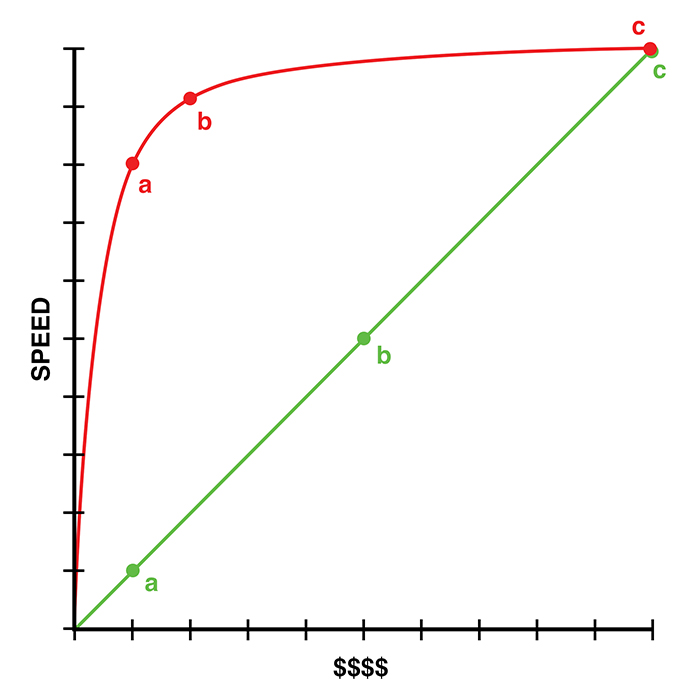
It turns out the salesman had spent many years racing motorcycles in the amateur circuit. One of the things he told us about his experience was really striking. He said that for not much money ($8-10k) you could walk into a dealership and buy a motorcycle that was almost as fast as the ones the pros raced. A talented rider on one of these stock bikes could expect to get within something like 90% of the professional circuit race times. So with very little effort you’d be 90% of the way there.

Then he said that if you spent an additional $25k (better tires, better exhaust, better injectors, better sparks plugs, etc) on that same stock bike, you could expect to get within 96% of the pro race times. So doubling your initial outlay could get you really close to the faster possible speed on a motorcycle of that size.

However, to reach that last 4% of professional times, you’d have to spend at least an additional $100k on specialized parts. He recited a whole list of parts (which sadly I can no longer recall), but I do remember that price. The main difference between the pros and the amateurs he insisted was largely that price point.

If you were to plot his data, it might look something like the red line on the graph below.

Honestly, I don’t know enough about the sport of motorcycle racing to fact check him, but the figures he recited surprised us. Both Teri and I had assumed that the progression from amateur to professional would be more linear, like the green line on the graph. We assumed that 10% of the cost would give you 10% of the speed, 50% of the cost would give you 50% of the speed, etc. That is, a set amount of effort would result in an equal amount of yield.

It was only later that I realized his progression of speed/cost ($5k, $25k, $100k) was pretty similar to what I had noticed in retouching.

As it happens I am an expert in photoshop, with well over 30 years of professional experience. One of the things I can say with some surety is that anyone can retouch. The Photoshop app is somewhat complex, but retouching with it is not rocket science. You don’t have to have an advanced degree in engineering to use it well. The only thing you really need is experience.

My breakdown on retouching goes something like this: (and yes, I am cribbing from Malcom Gladwell here) 100 hours, 1,000 hours, and 10,000 hours. These are the markers I look for to see how good you are. These numbers are not set in stone by any means. Use them only as a rough guide.

100 Hours
Put 100 hours of work into Photoshop and you will know something like 80% of what you need to be a professional retoucher. You obviously won’t know everything, but 100 hours is enough time to be familiar with most of the main tools, and how they work. Assuming an 8 hour work day, and a 5 day work week, then 100 hours comes out to be just short of 2 weeks. So put in 2 solid weeks of hard work in photoshop, and you’re most of the way to being a professional retoucher.

1,000 Hours
Put 1,000 hours of work into Photoshop and you will know something like 90% of what you need to be a retoucher. Assuming the same rate (8 hour day, 5 day work week) 1,000 hours equals 25 weeks, or about half a year of experience. Half a year is a lot. By then you will have learned most of all the little tricks, have developed a good sense of color matching, and will have learned most of what you need for complex tasks like layer stacking and embedding smart objects.

10,000 Hours
Put 10,000 hours of work into photoshop and there will be very little left I can teach you. In fact, I might be looking over your shoulder seeing what tricks I can learn from you. 10,000 hours is a good, solid five years of effort. Without question, this is a professional level. Honestly, you might be just as good in only 2.5 years, but one of the things I like about the 5 year mark is it’s about that point that you stop making most mistakes. You can know all you need to know before then, but it takes about that long to understand your weaknesses enough to compensate for them. At this point you not only know the work, but you are now looking over your process and tweaking it in little ways to generate slightly better outcomes.

Okay, so that’s a rough scale to follow, but this post isn’t about photoshop or motorcycle racing. It’s about how all types of craft follow this same principle. No matter which art you practice, your progression through it will not be linear, but roughly logarithmic. But (and this is the important part) to those around you, your path will appear to be linear.

There’s two parts to that, so let me deconstruct it a little. The logarithmic path is the way we do art. All of us. It doesn’t matter if we are talking painting, poetry, songwriting, silver-smithing, or quilting, The path to being an expert is the same. It takes about 100 hours to get to know what you’re doing, another 1000 to refine your skills to a fairly sharp point, and roughly 10,000 to pretty much discover every mistake. There are reasons for this progression, but I’m not going to go into them at this time. Again, Malcom Gladwell does a decent job of the topic in his book Outliers (though I wouldn’t believe every word he writes), but there is actual research behind the concept. The numbers are not set in stone, but they make a good rule of thumb. If you’re just learning an art, then this gives you a good idea of what to expect.

And to be clear, there are no shortcuts to this either. I know when you start out doing an art that you want to believe that you have some innate ability which will take you to expertise in less time. I know I do this, and have with every craft I’ve practiced. But the simple truth is, there’s no such thing. Everyone who wants to be an expert needs to put in the hours. Period. When we talk about doing things the hard way, this is what we mean. Yes, it’s difficult. Join the club.

(btw, this is good advice. Do join the club. Be involved with other professionals if you’re practicing a craft that pays well. Their wisdom will help you, and you might just shave a handful of hours under their guidance. But most importantly, you will be around people who are closely aligned to you. This is its own kind of balm. I never have to worry about explaining crazy clients to my other retoucher friends. They all get it. We have a shared emotional experience that is impossible to replicate.)

So back to the topic
This algorithmic progression (100, 1000, 10,000) is roughly the shape of our paths as creative people. But to an outsider these paths will look different. Remember how I said my wife and I were surprised at the cost of a motorcycle compared to its relative performance? This is because we all tend to think of things as being linear. That is, we assume the results should equal the effort. I assume this is just a flaw in human reasoning. I’m not sure of its origin or why we are affected this way, but we are. Perhaps we have an inherited sense of justice, and in a just world 20% effort would equal 20% ability. Thankfully the arts do not work this way. Honestly, most of them are too difficult. If we got relatively poor results early on, then we’d give up. I know I would.

So what this means is that when you put in your 100 hours, your friends and neighbors will look at you and see you are 80-90% of the way to becoming an expert. Naturally, they are going to assume you’re almost there. If 100 hours got you to 80%, then all you need is another 20 more hours and you will have nailed it. Makes sense, right! I mean, that is a linear progression.

The thing is, we’ve all seen this or done this. This part is very normal. Someone you know in high school or a neighbor picked up a pencil in art class and at the end of the semester they could seriously draw. Or they picked up the guitar, or they started singing in choir. It doesn’t matter what art or craft, the results are always the same. 100 hours of serious effort yields a huge amount of ability. And it’s naturally easy to assume success will follow.

But ask any expert in their field and you will get an entirely different response. If someone showed up at my door with 100 hours in photoshop and wanted a job, I would laugh. Someone without any experience at all might look at their abilities and think they’re pretty good, but I would see all of their flaws. This is EXACTLY the situation that every creative goes through when doing their art. This is why I recommend that if you want to be an expert in your art or craft, you work to professional standards. My point here is that those wishing to attain success in their creative field will be measured by the experts, not the amateurs. And believe me, they will have something to say about it.

This is why I believe that overnight success is a myth. First of all, because I’ve yet to see someone who suddenly rocketed to fame that didn’t have 5 or more hard years of experience under their belts. But also because I know what it’s like from the other side. Every professional art or craft is littered with experts, women and men who have done their 10,000 hours (or the equivalent) and know what’s what. Do you think they’re going to let some upstart play with the big boys just because they are cute? Do you think they’re going to go easy on someone else, especially after they had to do it the hard way? Not a chance.

The problem is, you don’t see anyone doing all those years in the arts. Our culture is amazingly blind to this work. Movies are especially bad, compressing any real (and thus boring) work into a montage. Team America even has a hilarious song called Montage that makes fun of this phenomenon. Books are not much better, in part because it’s very hard to express the mind-numbing difficulty of putting in that time. It’s literally something you have to do, and it often feels terrible when going through it. Back when I was a musician there was a common trope that everyone needed to “pay their dues” to be any good. This is the closest I’ve seen to the concept of 10,000 hours being codified in reality. Even then it was a long time ago, and every time I saw the “dues paying” concept it was consistently presented as being wrong, or some kind of gatekeeping. The truth is you often don’t know what you don’t know until you learn it. And it’s almost impossible to teach some things short of experience. That’s not gatekeeping, that’s how the creative process works.

So to wrap this all up, we have this tendency to expect the world to behave in a linear fashion, but the practice of learning any art or craft is actually more logarithmic in nature. It is the difference between our perception and this reality that drives so much confusion, and perpetuates the myth of overnight success.

A few caveats. Probably the most important one is you don’t have to be an expert at every craft. It is totally okay to practice a skill and let it remain a minor one. I have maybe 20 hours of sewing in my whole life, and while I can inexpertly repair a few things, and sew a straight line on a machine, I have no interest in being anything more than this. You not only don’t need to be an expert at everything, but sometimes it’s healthy to intentionally NOT be an expert.

And some skills can sneak up on you. Over the Christmas holiday one of my sisters showed up with a whole bunch of cookies, all of them tasty. This was not a skill I’d noticed in her before. But then I got to thinking, If you only cooked 25 hours a year, starting at the age of 20, by the time you reached 60 you’d have put in a LOT of hours. Well over 1000. That’s enough to make anyone pretty good in the kitchen.

The second caveat is that expertise is not a guarantee for success. In a competitive field like acting, or writing, or music, expertise is often the minimal standard. I know more than one expert who put in the hours and then found it hard to find work. It happens. All that to say you can’t assume x hours somehow = success, only that you are proficient. Sometimes proficiency is all we get.

2025 round up

This is my attempt to keep an annual marker of my progress as a writer. The words are mostly for me, but I put them here so you can follow along as well, if that’s your thing. Much of last year was taken to marketing myself, something I am loathe to do. It’s one of those jobs that are necessary and boring and sometimes makes you feel icky, but no one else can do for you.

In 2025 I wrote:

1 novel. Not a Man to Back Down, which is book 2 in the Speaker for the Dead series. It is just over 100k words in length, and I will be sending it out today for my Beta readers. (if you wish to be a beta reader, send me an email, and I will hook you up).

6 new short stories from scratch. These are stories that were finished in 2025. Some may have been started earlier, but not finished. An additional story that was finished in 2019, and was “held for consideration” this year (but not purchased), I gave a heavy edit this year and then put back into circulation.

At one point in 2025 I had a full dozen stories out trying to find a home in the various places. For most of the year it was nine or ten stories out. Currently, I am down to seven that are out, with at least five that either need to be retired, or wait for the market to open for that type of story. All that to say, I am hustling.

1 story sold. C’mon Boys, a 6,700 word SF short story I wrote in 2024 was published by Baubles From Bones in December. I am still pretty excited about this.

A whole bunch of marketing materials: Bios, Query letters, Synopsis, etc., all in an effort to find a Literary Agent. I don’t know how much I wrote, but it was probably something like 4-5k words.

10 Essays on various topics, much of it related to be creative. All of them posted here.

Earned a whopping 74 rejections for short stories. When you have a lot of stores out, the rejection can come flying fast. Even the story I sold, C’mon Boys, was rejected seven times before it was purchased.

Got turned down by 38 agents for both Speaker for the Dead, and Mind The Slice. This was pretty brutal. I sent out 38 packets and got all of them rejected. To be fair, this was my first time sending query letters. Next time I will switch some things around which should improve my chances slightly, but these changes are all pretty much window dressing. In truth, there are hundreds of thousands of novels written each year. A healthy percent of those novels are queried to agents in an attempt to get someone on the author’s team. My little letters are just one of thousands. Some agencies get hundreds of queries a week. No one can read them all, and make good decisions. Most agents only take on one or two new authors a year, if that. With thousands coming in, and only 1 or 2 going out, the math is not all that great.

This isn’t a complaint, this is a description of the process. Rejection is absolutely a guarantee. It’s also not necessarily meaningful. I mean a truly bad novel and a truly great novel can both be rejected, even if they are rejected for different reasons. And I don’t for a minute think I write great novels. I mean I try, but I’m also still learning.

Started a non fiction book on the nature of culture and stories. Right now it has no title. I’m not even sure of how broad it’s going to be. It’s one of those things that is so complicated I have to write about it to know what I’m writing about. But I’m researching and writing notes, and writing little 1k-2k diatribes that might one day be cobbled together into something meaningful.

2025 was not my most productive year in terms of writing fiction, but it was my most productive year in terms of selling stories and selling myself to an agent. I learned a lot, even if some of it was what not to do.

Read 65 books. I add this number here so you understand that it’s not just writing that I’m doing. There’s a whole lot of reading going on. Sometimes it’s for research, sometimes it’s for pleasure, and sometimes it’s a little of both. The majority of these I got at the library. I track everything I read now with an app called Reading List. I also use it to write little reviews of what I’ve read, mostly to remind myself of the story and what I got from it.

How to find fun in your creativity

Another post of unsolicited advice on how to make it in the creative world, from someone who has been in the trenches for a while.

Last week I wrote a post about intentionally making mistakes. I ended by mentioning that I have a technique to make your creative projects more fun. The good news is this is the easiest advice you will likely see from me. It is dead simple.

But first, a little explanation.

As I’ve said before, the path to becoming a professional creative is often a slog. It is work, work that is often bone-tiring and soul stripping. The fact that the work is necessary doesn’t always take the sting away from the process of making it. Sometimes your creative thing can be too much.

This is the dilemma of every creative person. To be professional we need to practice our craft at the highest levels. This means we have to be critical of our shit. But that very criticism can also be exhausting. Worse than just exhausting, it can strip away the simple joy we all feel at that spark of creation.

So what does one do? We need to be critical, but being critical is often too much?

My solution is to practice an art form for which you offer zero criticism. An art where you are free to do anything you feel, without reservation, and without care.

For me this is photography

My little secret habit

Mind you, I have friends who are professional photographers, and I work with professional grade photography all the time. It’s just when I’m shooting with my phone I ignore all that as much as possible. I don’t photograph to impress anyone, and I don’t try to make pretty images. I just try to capture as quickly as I can the mood or the vibe I see in front of me. If I have to think too much about it, I’m doing it wrong. Complexity is the last thing I’m interested in. Speed is of the essence. You could say I am shooting from the heart, not the head.

My phone is littered with hundreds of these shots. Weird, abstract, silly, or just fun. Sometimes I post them on social media, but for the most part they remain something just for me. My little secret habit.

The key part as I mentioned above is I offer no criticism of these photos, nor do I try to make them professional. I have more than enough of that in my work life. What I don’t have professionally is something that is open to the mood of the moment; to the now. When I am shooting like this I am very much in the now, and very much not in my head.

I am also 100% in control, which is another reason to practice a craft like this. My professional work as an artist is not only criticized by me, but by others, all the fucking time. I cannot tell you how exhausting this is. Weird people that I don’t know, and who have very poor taste, will offer criticism of my work that I have to follow. Da fuq? Mind you, don’t cry for me over this. I mean I’m getting paid for their criticism, and paid well, but that doesn’t mean it doesn’t often rub the wrong way. But in my little world of just me and my phone I am the one in charge, and what I say goes.

Almost any craft can be practiced this way. I often do something similar in writing, where I will purposely write a scene in another voice just to get a feel for how it lands. I’ve written a few very short stories this way. I’m apt to post them on FB, but only because I don’t want to subject them to the criticism of making them a “professional” story. They are intentional throw aways, experiments that are fun to write, but should not be taken seriously.

I also on occasion cook like this, taking a regular recipe and then messing with it. With cooking I have to be somewhat careful. I cannot get too crazy if I’m feeding my family, but if it’s just for me, then why not? A little chilly powder on your popcorn? Sure. A pinch of brown sugar on your bacon? Hell yes.

For years Teri has made pancakes every Saturday, and for almost as long I’ve been making my own syrup. The main three ingredients are: frozen fruit, honey, and cinnamon. I follow no recipe and often tweak it. The trick to syrup is knowing that when you heat fruit it will release its liquid. A handful of frozen berries will be plenty runny after a minute in the microwave. A fork breaks up the rest into small pieces. If it’s too runny I thicken with banana (which also sweetens). If it’s too bitter I add more honey. If it’s too bland I add more cinnamon (or ground nutmeg, or pepper, or chili powder, or…) I don’t measure, and I don’t think. I add to taste, and eat every result. Simple and fun, and endlessly open to creativity.

One can cook without criticism, or paint, or act, or dance, or even needle point. Hell you can even make t-shirts like this. The key is to keep your work innocent of criticism. It should have absolutely zero professional intent. It can’t be a money thing for you, or a side-hustle. Most of all, you can’t think too much about it. It needs to be the pure spark of creativity, with none of the baggage that follows.

This is you, creating your own work just for yourself. It’s your own special thing set up in your own special place, where no one else is allowed. Or, as I like to think of it, it’s your creative vomit, barfed up on the road in a place so remote that no one else has to smell it.

your creative vomit, barfed up on the road in a place so remote that no one else has to smell it

However you wish to call it, the key is to keep it loose and fun. You are digging in your raw id here, playing inside your own head. The work remains holy, but only so long as you don’t care too much about it. You are practicing the “do” of creativity, not the “why,” training yourself to separate whatever mood you happen to be experiencing in the current moment from the work of creation.

The goal is not to make great work, but to make a great life, because in the end this is what you are aiming for: Making your life better by having a little more fun.

Making your life better by having a little more fun

Try it and see. Attempt beautiful things without thought or care. See what that does for your peace of mind.

Making mistakes with intent

Another post of unsolicited advice on how to make it in the creative world, from someone who has been in the trenches for a while.

Last week I wrote a post about Failure. In it I talked about the importance of failure, and how you need to embrace your failures in order to become a professional. I made four key points about failure. They are:

You don’t need to aim for failure, it will come on its own.
Try not to make the same mistake twice.
Keep your mistakes to yourself, don’t dump them on others.
Own your mistakes when they happen.

I still stand by all of those, but this post is going to be a little different. It’s more about the nuts and bolts of doing art – the process of being creative – and less about the philosophy of art or about being an artist. You don’t have to be an artist to follow this advice. It pretty much works with every task.

In simple terms, when you do creative work you need to make mistakes.

Now I know this sounds counter to what I wrote last week, so let me explain some.

As I have posted before, in my day job I am a finisher. This means I am given a poster design called a comp (usually done in photoshop). My job is to upscale this comp to the proper resolution, repopulate all the photos with higher resolution images, and finally make all the photos blend well together. Depending on how well the comp has been built my job can be anything from mind-numbingly routine, to extremely difficult.

The difficult ones I always complain about, even though they provide the most creative freedom. There’s something deeply satisfying about turning a really soft, low resolution image into something sharp and high res, but the process is a lot of work, and causes a lot of stress. Sometimes you are literally painting a face into existence from a few stray pixels. The most difficult parts (the eyes and mouths, because they are the parts that the human eye looks at first) are very demanding. Even the most subtlest of changes can affect the entire piece.

Treatment for the movie Run Fat Boy Run done ~2008
Sometimes you are literally painting a face into existence from a few stray pixels

But it’s the easy parts that give me the most grief. The simpler the job (simple meaning less work for me) then the less vested I will be in the final art. Basically, I find it hard to care if I’m not fully engaged. And when I am less engaged I make more mistakes. In very simple terms you could say:

Boredom = Mistakes

At the end of my post on Failure I mentioned that the professionals I respect the most in my field go to great lengths to reduce the chances of making mistakes. This is why. Easy work leads to dumb mistakes.

This is true in every art form. Almost every author will tell you that when the story is really flowing that writing is a joy, but ask that same author what they think about facing copy edits for days on end and you will get a different reply. I know photographers who will jump at the chance to set up their lighting until everything is just right, but then struggle by the 100th shot at keeping the subject in focus.

This isn’t a problem with the creative process, it is a problem with the human brain. Our minds crave novelty, and seek out complexity. If your brain cannot have these things it will start to tune out. And no, it’s not an ADHD thing. It’s a flaw in how our brains are wired. Everyone’s brain does this, not just us skittish and sensitive creative types.

And this is why I say you need to make mistakes. Not to have yet another thing to clean up in your project, but to keep yourself just interested enough that you maintain your focus. You need to make little (and known) mistakes to keep from making large (and unknown) mistakes.

See? Simple. 😉

Here’s where it gets complicated. Only you can tell when your attention is starting to drift, so only you can tell when it’s time to start making mistakes. You have to sense your mood, and keep careful tabs on your mental state. This is by far the hardest part in the process. You have to know yourself well enough to know when things are going wrong. Once you can do that, the rest is easy.

Some examples:
I am blessed because photoshop is such an incredibly flexible app. There are almost an infinite number of ways to fix something. With the exception of resolution and color spaces, almost any solution is a functional one. True, there are some techniques which are better than others, but for the most part you can be creative in the way you fix things. And this part is key. You can intentionally switch things up.

Do you color correct using Curves and Hue/Sat? Try using Levels and Color Balance. Do you draw hair from outside to in? Try going inside to out.

If you’re a musician, try playing a song in a different key or tempo. Play that hard rock song like the deepest of country tunes, and see what that does for you. Switch to a minor key, play it like a polka. Do what it takes to make it new.

If you’re a painter, try painting with a different technique or color. If you’re a writer, try writing in a different voice or style, or have your character do something they would NEVER do.

The point is not what technique you use, it’s what happens to your brain while you’re doing them. Using a normally unused technique will change how you think. I will automatically make your brain focus more, making you more engaged.

Just making the attempt is the important part. It doesn’t even have to be useful. I often try two or three different techniques until I find one that works. The ones that don’t work I throw out. The goal is not just a final technique, but an engaged brain. Don’t be afraid to try and fail two or three times or more. You’re mining engagement here, and sometimes you have to prime the pump to get your brain flowing again.

The trick is to keep your attempts small and constrained. Don’t spend a lot of time thinking about it. Just do it and see what it does. Every mistake should be easy to repair, though I think you’ll be surprised at how many you eventually keep. You don’t want to do something that can spike your project, just something that can nudge your brain into a more focused state.

Besides having less mistakes in your final work, this technique also helps by giving you a more flexible approach to your craft. It is very easy to get all caught up into doing the same process over and over. Sometimes only one procedure will do the job properly, it’s just not always the best thing for your brain.

Basically, you are already creative in your craft, so why not be creative about your techniques as well? Use your creativity to make things better for you, and cause less mistakes.

I think that’s it for this week. Next week I have a technique to make your creative projects more fun.

On failure

More unsolicited advice on how to make it in the creative world, from someone who has been in the trenches for a while.

Years ago, back when I was single, I was hanging out at a coffee shop with Clark Souter who is a close friend. We got to talking with a young lady who wanted to break into jazz as a harpist. Clark is an amazing musician, and I’ve dabbled at it once or twice, so we had a lively conversation. At some point the topic turned to failure, and at that moment Clark and I started listing our failures. We didn’t just go half-way either. We went hard and deep, as young men are apt to do. Proud to show off our scars as it were. Mind you, Clark and I go way back, so we knew from what we were talking. And we didn’t pull any punches.

What I remember most while he and I cheerfully listed all the big mistakes we’d made, back and forth, laughing the whole time, was this poor young lady’s jaw getting lower and lower. Let me tell you, that poor woman was shocked. I guess she wasn’t used to creative types speaking like that.

In Los Angeles, you get used to others being supportive of you. One of the things I love about this town is if I tell my friends something ridiculous like I want to be an underwater rodeo clown, they’ll reply, “That sounds cool.” And then almost immediately follow it up with something like, “And you know, I bet you’d be good at it too.” Encouragement is common down here, and expected. Sure, I’ve met some artists who aren’t like that, but they’re the exception not the rule. Back in the small town where Clark and I grew up, you’d get a different reaction to that kind of statement. People would say, “You can’t have an underwater rodeo.” Or ask, “Why do you wanna do that?” Or say, “What’s wrong with driving a truck?” Basically, they’ll give every kind of passive-aggressive negative response you can think of. In a small town, the crime of dreaming big dreams is punished because you are rocking the boat. If you succeed it’s seen as a black mark on them. Whereas in a big city big dreams are expected. After all, everyone else came here to make it too, so there’s kind of an appreciation of the struggle. Hop on board. We’re all trying to make it here.

But what Clark and I were doing that day was more than blind support. We were being honest about the process. If you are used to someone weaponizing your mistakes against you, which is far too common in this world (believe me, I have those stories too), then listing all your failures out loud in public sounds suicidal, like you are giving ammunition to your enemies. The thing to remember among friends who are genuinely supportive, is that failure is not a weapon. It’s a tool for improvement. Failure is how we learn. It’s how we get better. It’s how we become professional.

A while back I wrote a post on making it as a creative called So You Want to be an Artist. In response to it, a cousin from back home sent me a link in FaceBook about creativity. The link was to a video that featured excerpts from a Ted Talk by Sir Ken Robinson called Do Schools Kill Creativity?

The talk starts off about children being willing to be wrong at things, much more than adults. Then he gives this great quote,

If you’re not prepared to be wrong, you’ll never come up with anything original.

I endorse this part of the video whole-heartedly. I suspect this is why my cousin sent it to me. Failure is not an option in the creative process. It’s a requirement. Often failure is the key to success. Sometimes you have to fail every other possible way before you can succeed. It sucks, I know, but it happens.

Unfortunately, the whole rest of the video is a mess. It goes on to suggest that because adults no longer make mistakes like kids, then obviously we’re teaching kids to be afraid of mistakes. Schools are bad, blah, blah, blah. He even says, “We are educating people out of their creative capacities.” To which I want to respond, “200 years ago, when most people were not educated, did we have a significantly more creative population?” When the obvious answer, “No,” is given, I would follow with, “My brother in Christ, doesn’t that indicate the world does this to us anyway?”

But enough of that crap. Let’s talk about mistakes for a minute. The kinds you want to make, and the kinds you don’t. And yes, I’m going to Not All Mistakes here, because it really is important what kind of mistakes you make. There are wrong ones and right ones. So let’s get to it.

Don’t aim for failure. Aim for success. Failure will naturally come on its own.
My first point would be to not try to make mistakes to begin with. The goal is to try to be the best you can be at your creative task. Just do that and it is guaranteed you will screw up. Trust me on this. Your work can be too rigid, or too earnest; too boring, or too over-the-top. It doesn’t really matter. You will find a way to screw it up somehow. We all do. After all, you’re attempting to get better, and getting better often means first being worse. No one starts at number 1. We all start at the bottom, and work our way up. Succeeding means trying, sometimes over and over, until the right combination of things “click”. By definition, all those previous attempts were failures, they just happened to be failures that pointed you to success.

Don’t make the same mistake twice.
The second point I would make is to try and not make the same mistake twice. Failure is a learning tool. This is its most valuable feature, so learn from it when it comes. “What did I do wrong?” “How can I improve?” These are the questions you should be asking yourself over and over. Again, yes the process sucks, but it’s better than quitting. This is how every pro you will ever meet in any creative field got there. They mistaked their asses off until they got better. You can too.

Keep your mistakes to yourself, and your art.
The third point (and perhaps the most important) is you want to keep your mistakes within your art of choice, and not in your life. It’s okay to be creative in your photography, but not with the money you need to pay the rent. It’s perfectly valid to drop an F bomb in your novel, but not in the emails you send for your day job. It’s one thing to experiment in the kitchen for your own dinner, but another thing entirely when the meal is also for your roommate. Go ahead and eat your mistakes, every good chef does, but don’t expect others to have to partake as well. You 100% don’t get to make your mistakes in the lives of others. This is called being an asshole. Being an artist is no excuse for shitty behavior. After all, they are not the one trying to make it, you are.

Own your mistakes, out loud.
And finally my last point, be honest and open with everyone when you fuck up. This is especially important when you are involved in a group art form like playing in a band, or making movie posters. When others are relying upon you to complete a creative task, pretending you didn’t make a mistake doesn’t make things better, it just makes things worse. And yes, it absolutely sucks when everyone is waiting on you and you keep screwing up.

I remember one time years ago, we were working on a bunch of outdoor pieces (billboards, movie posters, bus shelters, bus sides, etc) for a TV network. They were releasing a bunch of TV shows for a new season, and wanted all the advertising for each show to be unique and yet have a similar design theme so they were “of a piece.” All of them were going up in New York, featured in one place (for a convention I think), and all of it was under an insanely tight deadline. And in the middle of this insane week I was having a problem.

Occasionally we have to illustrate hair on people. Not the whole mass of hair, just the edges, so they look natural. This is part of cutting one head from one photo and adding to another body in another photo. The process is called photo-compositing, and finishers like myself do it in our day jobs all the time. To make it look right you often draw a lot of little hairs that fly away from the main hair mass. The problem I was having is that my hair edges didn’t look right. They looked wrong, drawn in. If done right, you cannot tell that they are not part of the original photo. If done wrong they look like someone let child paint them in photoshop. And that day, at that time, I could not do them. My hair looked like shit. Everything else I could do, but not hair. To this day I don’t know if I just lost my nerve, was especially stupid that week, or what. Normally I could do hair, but in that time and place I could not.

Fortunately I was just a freelancer. The agency had a Lead Finisher on staff, a wonderfully talented man by the name of Marco Blanco. After about the fifth time an art director told me the hair I was doing wasn’t cutting it, I had to go to Marco and tell him I can’t do the hair on this project. Let me tell you, that was super embarrassing. As a professional Finisher I prided myself on doing good work, only in this case I could not. Plus there was a huge financial risk. The client could have dropped me from the project or even from that agency. I only make money when someone calls me, and the VERY LAST THING I needed right then was a hit to my reputation.

Marco was not happy, but he was (and is) a pro of the highest caliber. We worked out a system where I did the majority of the work and then gave the file to him to finish the hair. It was embarrassing, but the work went out on time, and everyone got paid. And I have never had that problem since. I’ve had people ask me to change some of the hair I draw in. Sometimes I’ve had to entirely rethink how to do the hair for a piece, but I’ve never failed like that since.

One final point.
When you pursue a craft for many years, there comes a point where you make less and less mistakes. This is not an outcome (like sir Ken would like you to believe) of an education system or your job. It’s a natural extension of my second point, not making the same mistakes twice. If you try not to make mistakes twice, then after a while you stop making them. You’ve basically run out of mistakes to make. Oh, you will still make them, we’re all human, but they become so few and far between that they are almost like finding a lost jewel. Oh goody, I get to learn something new today.

In fact, the professionals I respect the most in my field go to great lengths to develop ways to reduce the chances of mistakes coming from anyone. They essentially engineer an art workflow that makes mistakes really hard to do, and when they do come up, really easy to fix. Far from showing a lack of creativity, this shows they are a master of their craft, and have a professional’s understanding of the cost of mistakes. Mistakes are allowed to happen, they just can only happen in small areas, and at little cost.

And in a professional environment, this is the highest one can get in a creative field. You keep your mistakes to righty controlled areas of exploration, always keeping a weather eye on the cost.

That’s enough for today. Next time I’ll talk about how I use mistakes in my everyday work.

First sale

I am very proud that my first professional sale to Baubles from Bones is up today.

C’mon Boys
The Unofficial History of United Hull Scrapers Interplanetary Local 479


As it says on the tin: A bored robot discovers labor rights in a town humming with radiation. 

I put a lot of charm into this one. Give it a read. See if it doesn’t make you smile.

If the universe has been kind to your wallet, please consider passing some of that along to Elyse and Joel, and the others. This magazine is a passion project for them, and it shows.

So you want to be an artist

Unsolicited advice on how to make it in the creative world, from someone who has been in the trenches for a while.

Many years ago I had a job as a delivery driver for a rental company. This was back when I was around 19 or 20. By then I had completed exactly one year of college before dropping out to play in a Christian rock band. The Christian part was new, but the musician part was not. (spoiler alert: I’d eventually fail at both). 

Music was the first art form I’d tried that I could unselfconsciously immerse myself in. Oh, I’d been doodling since elementary school, but I could never draw uncritically. I was always finding fault with my work. It was never good enough. Besides, I never saw myself as an artist. My mom was an artist and taught art, so I had a pretty clear idea about that path, and I was sure it wasn’t for me (spoiler alert: I’ve been a professional artist for over 30 years now). The important part here being I could see myself as a rock musician. The music wasn’t that hard, and the rewards (money, fame, girls, and drugs) all were enticing. It was a future I could embrace. It was my shortcut to success and adulthood.

Besides, music was fun to play.

All I had to do was try hard, and eventually I would succeed. Someone would notice my drive, my earnestness, and pick me from the crowd. Then my life would be nothing but limousines and pretty girls, and no more cares about money.

And why not? This pattern had always worked for me before. I was quirky, which meant I had that perfect blend of creative and smart. Teachers for the most part liked me. I was exciting to have in a classroom. I was surprising (in a good way). I had potential. The way I figured, if I was always going to be somebody, I might as well be the somebody I wanted, and right then I wanted to be a rock star.

And I REALLY WANTED IT. I was an unknown kid from a shit little town, struggling (and failing) to remain middle class. I had all the desire you could want. I NEEDED it with a white hot WANT, and I wasn’t going to settle. I was going to have it all.

Somewhere along the way I also became a Christian, but this was not an impediment to my musical success. Quite the opposite. I’d been listening to Christian music, and realized there was a dearth of good rock songs about God. Most of it was pretty tame in comparison to the secular rock I’d loved so much.

So I went for it.

It was somewhere during that time that I worked for this rental place. The job, as I told everyone in ear shot, was only a stepping stone. Success, real success (meaning rock star fame and fortune) was just around the corner. Sure it was the Christian version of rock star, so less drugs and more earnestness, but I was good at being earnest. So it was no surprise that on a slow day I pulled out my guitar to practice in the back. 

The boss had recently hired a new guy named Steve. (I’m sad to say I forget his name, so I’ll call him Steve) Steve was a little older, and probably a lot wiser, but we got along okay. He worked up front with the customers (something I didn’t do well), and I drove delivery. Still, we were close enough that when he heard me practicing, he came walking to the room, past all the half assembled lawn mowers and dirty dishes, wearing an expression in his face like he was close to tears. Then as he approached he got down on his knees in front of me, clasped his hand together as if in prayer, proceeded to blubber. 

For those of you who grew up in the church, he was mimicking an altar call. For those who didn’t earn their merit badge in exuberant protestantism, he was faking the spiritual ecstasy of someone about to have a conversion experience. Mind you, I knew he was being funny, I even knew he was being funny at my expense, I just didn’t understand why. I laughed, because it was funny, but I didn’t get what he was doing. Why was he making fun of me in that way?

I know now it was because I was exuding desperation and earnestness like a bad cologne. Exuding it so hard it made everyone around me uncomfortable. I was practically screaming my want to the world.

And it wasn’t enough.

Many years later, I was living in another town (Los Angeles) and working in another industry (entertainment advertising). By then I was a professional, earning a professional wage. I even had my own office. I worked for a small division of a slightly larger company. I had also met Teri by then and was either engaged or about to be engaged. Basically I was in my mid 30s, and settling down. I was also having a kind of crisis. 

See, at the time I was a finisher, which is the last person to touch a piece of art (like a movie poster) before it is printed. My job was to take designs that had been put together with more speed than skill, and make them into a cohesive piece of art. Finishing is a job that is more technical than creative. The big design ideas have already been worked out. Your job is to make sure all the fiddly bits, all the small details, work together. 

My problem was, I didn’t find the work creative enough. 

Most of the people I worked with were finishers like me. We’d come into the business from the technical side. None of us had gone to art school. None of us were deeply creative (or creative as I saw it then). So when we got a new boss for our division, one who was both an outstanding Illustrator and a photographer, I took him aside one day and asked him how one got to be a designer. 

His name was Michael Elins, and while his advice was a little mixed (he’s a much better visual artist than a writer), and full of exacerbation with me, (he must have thought my question was like asking a fish why they liked water) still, his words have stuck with me to this day. What he told me was that a designer didn’t just do designs. They got design magazines, they went to art shows, they made friends with other designers, they worked at design agencies. It wasn’t just a job, it was a whole experience.

The feeling I got from him was design was a kind of lifestyle. As if design was something one did, like being gay, or being a banker. It was a whole package.

This was a lot closer to the truth than Steve’s display at the rental place. But it took me a few more years to have both of them make sense.

Basically, what I think Michael was hinting at was that an artist first and foremost does art. That is, they do the work of being an artist. This is not unlike something that authors often say: A writer writes, or a painter paints. The main point being, it is not enough to want to be something like a designer or a rock star. You have to do the work. 

The key is not desire. You can have all the desire in the world and still not succeed. The key is in the work. It’s not enough to grow out your hair, or pierce your ear, or say all the right words. 

The thing is, much of the world doesn’t work this way. To be a Christian all you have to do is say you are. The same is true for most jobs that are considered unskilled. No one is going to check to see if you are really a dishwasher or a waiter. Sure there are limits to what you can say about yourself, but for much of the world, especially much of the middle class world, “fake it til you make it” is a tried and true recipe for success. 

It just doesn’t work in the creative world.

About a month ago, a very successful author posted something on FaceBook  about “being” an author. They were giving the tried and true advice I included above: A writer writes. Many of the replies showed that the other fans of this author were not “getting it”. They were under the impression that if you had a good enough idea, or sufficient raw talent, then that was enough. 

I don’t blame them, it took me decades to work this out, mostly by failing, over and over.  So allow me to save you that failure if I may.

The reality is this: If you want to make a living in a creative field you’re going to be facing a long uphill battle. I promise you, it will be a slog. There are three major reasons for this.

The first is about the numbers.
The truth is there’s a lot more people who want to do the work than there is money, and there’s not a lot of money. Sure there are success stories, but these people are vanishingly rare. For every Stephen King or Elton John there are tens of thousands of people who you will never know doing the exact same work for next to nothing.

Because of this, to succeed, even at a modest level, means you have to find a way to separate yourself from the pack. It very much is a competition. To be better you need to do more than just want to be successful. After all, everyone else also wants to be successful, and some of them surely want it more than you. Really wanting something is just the floor, not the ceiling. It’s the minimum standard.

Sure, there is a component of luck to this as well, but luck will only take you so far.

The second is about the process.
You don’t get good at any craft (be it writing, or painting, designing, or playing an instrument) by doing it once a week or once a month. You have to do it over and over, hour after hour, year after year. You have to practice it until your fingers bleed and your hopes turn sour. You have to practice until you reach the point that you are sure no one else in the world is going to care, and then you have to practice some more.

The value of art is in the doing, not the thinking. You can have a million dollar idea for a movie or a novel, but until you do the work of making that idea a reality – something you can hold in your hands or show to others – it’s not worth two cents. Art without action is nothing. Ideas, like desire, are just the floor, not the ceiling. You need something else.

The third is about standards.
It’s not enough to do the work, you have to do it well. You have to be demanding of your creative output. You have to hold it to the white hot fire of criticism, and burn off all the bad parts. You have to develop a critical eye. You have to be willing to be discontent. You have to suck, over and over until your work starts to suck less; until you reach the point where you stop making the obvious mistakes and start making the subtle yet challenging real mistakes, and then start all over again.

This is the point Michael Elins was trying to convey to me all those years ago. Good designers are always comparing their work to other designers, usually the very best, and then working hard to perform at that level. They talk to other professionals in their field, they notice all the work that is being done, and they are fucking critical about it. Most importantly, they are critical of their own work.

The thing is, this part is hard, perhaps the hardest. Just having the ego to think that you can create, that your ideas are important, that something living only in your head needs to be in the outside world, is super difficult. Especially, if no one else in the world gives a damn. Sure, you can surround yourself with others who care. I was in several bands when I was a musician, but even that wasn’t enough. The enemy is always the person you face in the mirror. If you shit too much on your own work, if you are too critical, you can shoot yourself down and keep yourself from creating. If you are not critical enough then you can go on for years being mediocre and never understanding why you’re not finding success. It’s a very fine balance, and it is always changing.

And even then, even if you do all three of the things I mentioned above, your success is not guaranteed. You can go your whole life and only those close to you will see your efforts. Look up Larry Todd, of Aline Kominsky-Crumb. There are famous painters like Van Gogh, Cézanne, Monet, and Gauguin, who died before they became popular. Even authors like Sylvia Plath, Henry David Thoreau, Emily Dickinson, John Keats, Edgar Allen Poe, even fucking Herman Melville, all gained notoriety after they passed this earthly veil.

You can have all the desire in the world, you can do the work, and you can do the work at a very high level, and still not find success. That is the size of the mountain you are facing. All of us creative types face this, and yes it is fucking daunting.

But also, who cares? So what if it is hard? Everything is hard, everything is difficult. Just getting out of bed some days is too much. Don’t let the size of the thing fool you. It’s mostly in your head anyway.

Knowing all that, if you still want to be an artist here’s my advice:
First of all, if you want to be something, then be it. Don’t wait for someone else to give you permission. If you want to be a novelist, then write a novel. If you want to be a musician, then play your heart out. If you want to be the best chef in all of America, then start cooking up your own recipes. 

Don’t wait on desire, do the work.

If you want to make money at your passion, if you want your passion to be more than just a side hustle, then you need to not only do the work but mix it up with the big boys. That means you need to be critical of your art, you need to refine it, edit it, make it better. You need to make it the best you can, and then you need to find a way to make it better. This is a journey, and it is NOT going to happen overnight. Developing a critical eye for your shit takes time. This is why there is no such thing as an overnight success, because becoming a professional takes hundreds or even thousands of hours of patience and dedication. They don’t pass that out at the corner. If they did then everyone you know would be a success. 

Perhaps most important, if you tried to do something creative but didn’t have the wherewithal to take it to the top, DO NOT LOWER YOUR HEAD. Keep your chin up. You braved more than most. Failure is not a failure unless you decide not to learn from it, so learn. Maybe you’ll learn (like I did with music) that it’s just not an art for you. Maybe you’ll learn you just needed a break to let things settle down, before you start again. Maybe you’ll learn that it sucks and the big boys cheat (they do), and the work is totally unfuckingfun (it is).

Being a creative means taking it on the chin. Always. There is no path forward that doesn’t come with pain. Easy street is for suckers, not for us. Sometimes the only way to tell that you’re on the right path is when the blows come hard and fast and you keep going anyway.

But also, there is no shame in bowing out either. This is your life, you get to create it anyway you like. In fact, your life is your best creation. If you step down a path that gets too weird or too dark, it’s totally okay to walk away. Only you can set your standards, and only you are responsible to them. No one else should have that power over your passion, so don’t give it to them.

Bottom Line:
If you want to live, (not succeed, but live);
if you want to be happy (not content, but happy);
then you have to find joy in the work.

Find joy in what you do. Find joy in what you create. Find joy in the creative process. It could very well be the only happiness you will get from your passion, so celebrate it. Make the most of it. In the end, this is the only thing you are guaranteed.