Making mistakes with intent

Another post of unsolicited advice on how to make it in the creative world, from someone who has been in the trenches for a while.

Last week I wrote a post about Failure. In it I talked about the importance of failure, and how you need to embrace your failures in order to become a professional. I made four key points about failure. They are:

You don’t need to aim for failure, it will come on its own.
Try not to make the same mistake twice.
Keep your mistakes to yourself, don’t dump them on others.
Own your mistakes when they happen.

I still stand by all of those, but this post is going to be a little different. It’s more about the nuts and bolts of doing art – the process of being creative – and less about the philosophy of art or about being an artist. You don’t have to be an artist to follow this advice. It pretty much works with every task.

In simple terms, when you do creative work you need to make mistakes.

Now I know this sounds counter to what I wrote last week, so let me explain some.

As I have posted before, in my day job I am a finisher. This means I am given a poster design called a comp (usually done in photoshop). My job is to upscale this comp to the proper resolution, repopulate all the photos with higher resolution images, and finally make all the photos blend well together. Depending on how well the comp has been built my job can be anything from mind-numbingly routine, to extremely difficult.

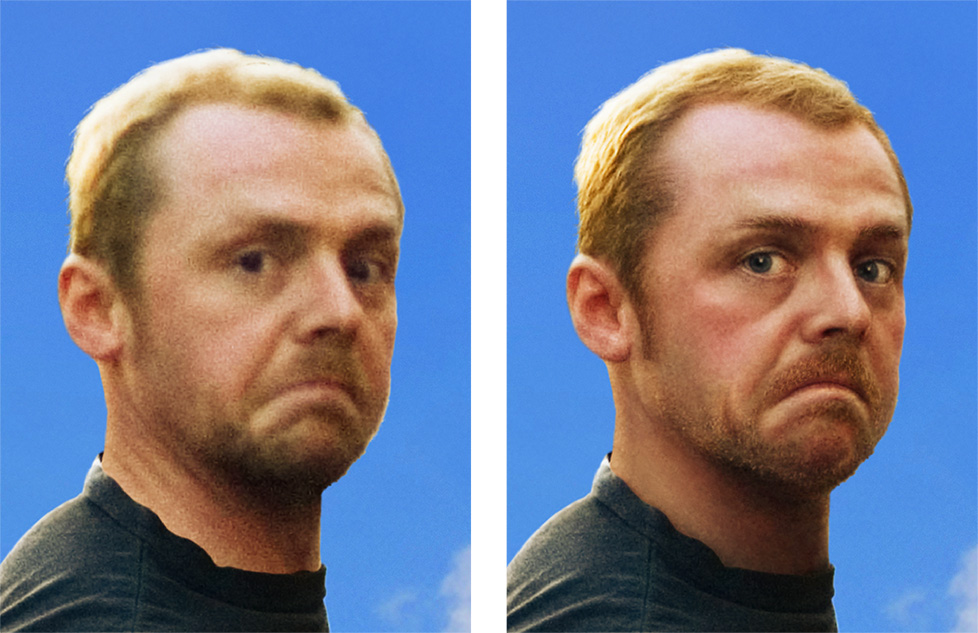
The difficult ones I always complain about, even though they provide the most creative freedom. There’s something deeply satisfying about turning a really soft, low resolution image into something sharp and high res, but the process is a lot of work, and causes a lot of stress. Sometimes you are literally painting a face into existence from a few stray pixels. The most difficult parts (the eyes and mouths, because they are the parts that the human eye looks at first) are very demanding. Even the most subtlest of changes can affect the entire piece.

Treatment for the movie Run Fat Boy Run done ~2008
Sometimes you are literally painting a face into existence from a few stray pixels

But it’s the easy parts that give me the most grief. The simpler the job (simple meaning less work for me) then the less vested I will be in the final art. Basically, I find it hard to care if I’m not fully engaged. And when I am less engaged I make more mistakes. In very simple terms you could say:

Boredom = Mistakes

At the end of my post on Failure I mentioned that the professionals I respect the most in my field go to great lengths to reduce the chances of making mistakes. This is why. Easy work leads to dumb mistakes.

This is true in every art form. Almost every author will tell you that when the story is really flowing that writing is a joy, but ask that same author what they think about facing copy edits for days on end and you will get a different reply. I know photographers who will jump at the chance to set up their lighting until everything is just right, but then struggle by the 100th shot at keeping the subject in focus.

This isn’t a problem with the creative process, it is a problem with the human brain. Our minds crave novelty, and seek out complexity. If your brain cannot have these things it will start to tune out. And no, it’s not an ADHD thing. It’s a flaw in how our brains are wired. Everyone’s brain does this, not just us skittish and sensitive creative types.

And this is why I say you need to make mistakes. Not to have yet another thing to clean up in your project, but to keep yourself just interested enough that you maintain your focus. You need to make little (and known) mistakes to keep from making large (and unknown) mistakes.

See? Simple. 😉

Here’s where it gets complicated. Only you can tell when your attention is starting to drift, so only you can tell when it’s time to start making mistakes. You have to sense your mood, and keep careful tabs on your mental state. This is by far the hardest part in the process. You have to know yourself well enough to know when things are going wrong. Once you can do that, the rest is easy.

Some examples:
I am blessed because photoshop is such an incredibly flexible app. There are almost an infinite number of ways to fix something. With the exception of resolution and color spaces, almost any solution is a functional one. True, there are some techniques which are better than others, but for the most part you can be creative in the way you fix things. And this part is key. You can intentionally switch things up.

Do you color correct using Curves and Hue/Sat? Try using Levels and Color Balance. Do you draw hair from outside to in? Try going inside to out.

If you’re a musician, try playing a song in a different key or tempo. Play that hard rock song like the deepest of country tunes, and see what that does for you. Switch to a minor key, play it like a polka. Do what it takes to make it new.

If you’re a painter, try painting with a different technique or color. If you’re a writer, try writing in a different voice or style, or have your character do something they would NEVER do.

The point is not what technique you use, it’s what happens to your brain while you’re doing them. Using a normally unused technique will change how you think. I will automatically make your brain focus more, making you more engaged.

Just making the attempt is the important part. It doesn’t even have to be useful. I often try two or three different techniques until I find one that works. The ones that don’t work I throw out. The goal is not just a final technique, but an engaged brain. Don’t be afraid to try and fail two or three times or more. You’re mining engagement here, and sometimes you have to prime the pump to get your brain flowing again.

The trick is to keep your attempts small and constrained. Don’t spend a lot of time thinking about it. Just do it and see what it does. Every mistake should be easy to repair, though I think you’ll be surprised at how many you eventually keep. You don’t want to do something that can spike your project, just something that can nudge your brain into a more focused state.

Besides having less mistakes in your final work, this technique also helps by giving you a more flexible approach to your craft. It is very easy to get all caught up into doing the same process over and over. Sometimes only one procedure will do the job properly, it’s just not always the best thing for your brain.

Basically, you are already creative in your craft, so why not be creative about your techniques as well? Use your creativity to make things better for you, and cause less mistakes.

I think that’s it for this week. Next week I have a technique to make your creative projects more fun.

On failure

More unsolicited advice on how to make it in the creative world, from someone who has been in the trenches for a while.

Years ago, back when I was single, I was hanging out at a coffee shop with Clark Souter who is a close friend. We got to talking with a young lady who wanted to break into jazz as a harpist. Clark is an amazing musician, and I’ve dabbled at it once or twice, so we had a lively conversation. At some point the topic turned to failure, and at that moment Clark and I started listing our failures. We didn’t just go half-way either. We went hard and deep, as young men are apt to do. Proud to show off our scars as it were. Mind you, Clark and I go way back, so we knew from what we were talking. And we didn’t pull any punches.

What I remember most while he and I cheerfully listed all the big mistakes we’d made, back and forth, laughing the whole time, was this poor young lady’s jaw getting lower and lower. Let me tell you, that poor woman was shocked. I guess she wasn’t used to creative types speaking like that.

In Los Angeles, you get used to others being supportive of you. One of the things I love about this town is if I tell my friends something ridiculous like I want to be an underwater rodeo clown, they’ll reply, “That sounds cool.” And then almost immediately follow it up with something like, “And you know, I bet you’d be good at it too.” Encouragement is common down here, and expected. Sure, I’ve met some artists who aren’t like that, but they’re the exception not the rule. Back in the small town where Clark and I grew up, you’d get a different reaction to that kind of statement. People would say, “You can’t have an underwater rodeo.” Or ask, “Why do you wanna do that?” Or say, “What’s wrong with driving a truck?” Basically, they’ll give every kind of passive-aggressive negative response you can think of. In a small town, the crime of dreaming big dreams is punished because you are rocking the boat. If you succeed it’s seen as a black mark on them. Whereas in a big city big dreams are expected. After all, everyone else came here to make it too, so there’s kind of an appreciation of the struggle. Hop on board. We’re all trying to make it here.

But what Clark and I were doing that day was more than blind support. We were being honest about the process. If you are used to someone weaponizing your mistakes against you, which is far too common in this world (believe me, I have those stories too), then listing all your failures out loud in public sounds suicidal, like you are giving ammunition to your enemies. The thing to remember among friends who are genuinely supportive, is that failure is not a weapon. It’s a tool for improvement. Failure is how we learn. It’s how we get better. It’s how we become professional.

A while back I wrote a post on making it as a creative called So You Want to be an Artist. In response to it, a cousin from back home sent me a link in FaceBook about creativity. The link was to a video that featured excerpts from a Ted Talk by Sir Ken Robinson called Do Schools Kill Creativity?

The talk starts off about children being willing to be wrong at things, much more than adults. Then he gives this great quote,

If you’re not prepared to be wrong, you’ll never come up with anything original.

I endorse this part of the video whole-heartedly. I suspect this is why my cousin sent it to me. Failure is not an option in the creative process. It’s a requirement. Often failure is the key to success. Sometimes you have to fail every other possible way before you can succeed. It sucks, I know, but it happens.

Unfortunately, the whole rest of the video is a mess. It goes on to suggest that because adults no longer make mistakes like kids, then obviously we’re teaching kids to be afraid of mistakes. Schools are bad, blah, blah, blah. He even says, “We are educating people out of their creative capacities.” To which I want to respond, “200 years ago, when most people were not educated, did we have a significantly more creative population?” When the obvious answer, “No,” is given, I would follow with, “My brother in Christ, doesn’t that indicate the world does this to us anyway?”

But enough of that crap. Let’s talk about mistakes for a minute. The kinds you want to make, and the kinds you don’t. And yes, I’m going to Not All Mistakes here, because it really is important what kind of mistakes you make. There are wrong ones and right ones. So let’s get to it.

Don’t aim for failure. Aim for success. Failure will naturally come on its own.
My first point would be to not try to make mistakes to begin with. The goal is to try to be the best you can be at your creative task. Just do that and it is guaranteed you will screw up. Trust me on this. Your work can be too rigid, or too earnest; too boring, or too over-the-top. It doesn’t really matter. You will find a way to screw it up somehow. We all do. After all, you’re attempting to get better, and getting better often means first being worse. No one starts at number 1. We all start at the bottom, and work our way up. Succeeding means trying, sometimes over and over, until the right combination of things “click”. By definition, all those previous attempts were failures, they just happened to be failures that pointed you to success.

Don’t make the same mistake twice.
The second point I would make is to try and not make the same mistake twice. Failure is a learning tool. This is its most valuable feature, so learn from it when it comes. “What did I do wrong?” “How can I improve?” These are the questions you should be asking yourself over and over. Again, yes the process sucks, but it’s better than quitting. This is how every pro you will ever meet in any creative field got there. They mistaked their asses off until they got better. You can too.

Keep your mistakes to yourself, and your art.
The third point (and perhaps the most important) is you want to keep your mistakes within your art of choice, and not in your life. It’s okay to be creative in your photography, but not with the money you need to pay the rent. It’s perfectly valid to drop an F bomb in your novel, but not in the emails you send for your day job. It’s one thing to experiment in the kitchen for your own dinner, but another thing entirely when the meal is also for your roommate. Go ahead and eat your mistakes, every good chef does, but don’t expect others to have to partake as well. You 100% don’t get to make your mistakes in the lives of others. This is called being an asshole. Being an artist is no excuse for shitty behavior. After all, they are not the one trying to make it, you are.

Own your mistakes, out loud.
And finally my last point, be honest and open with everyone when you fuck up. This is especially important when you are involved in a group art form like playing in a band, or making movie posters. When others are relying upon you to complete a creative task, pretending you didn’t make a mistake doesn’t make things better, it just makes things worse. And yes, it absolutely sucks when everyone is waiting on you and you keep screwing up.

I remember one time years ago, we were working on a bunch of outdoor pieces (billboards, movie posters, bus shelters, bus sides, etc) for a TV network. They were releasing a bunch of TV shows for a new season, and wanted all the advertising for each show to be unique and yet have a similar design theme so they were “of a piece.” All of them were going up in New York, featured in one place (for a convention I think), and all of it was under an insanely tight deadline. And in the middle of this insane week I was having a problem.

Occasionally we have to illustrate hair on people. Not the whole mass of hair, just the edges, so they look natural. This is part of cutting one head from one photo and adding to another body in another photo. The process is called photo-compositing, and finishers like myself do it in our day jobs all the time. To make it look right you often draw a lot of little hairs that fly away from the main hair mass. The problem I was having is that my hair edges didn’t look right. They looked wrong, drawn in. If done right, you cannot tell that they are not part of the original photo. If done wrong they look like someone let child paint them in photoshop. And that day, at that time, I could not do them. My hair looked like shit. Everything else I could do, but not hair. To this day I don’t know if I just lost my nerve, was especially stupid that week, or what. Normally I could do hair, but in that time and place I could not.

Fortunately I was just a freelancer. The agency had a Lead Finisher on staff, a wonderfully talented man by the name of Marco Blanco. After about the fifth time an art director told me the hair I was doing wasn’t cutting it, I had to go to Marco and tell him I can’t do the hair on this project. Let me tell you, that was super embarrassing. As a professional Finisher I prided myself on doing good work, only in this case I could not. Plus there was a huge financial risk. The client could have dropped me from the project or even from that agency. I only make money when someone calls me, and the VERY LAST THING I needed right then was a hit to my reputation.

Marco was not happy, but he was (and is) a pro of the highest caliber. We worked out a system where I did the majority of the work and then gave the file to him to finish the hair. It was embarrassing, but the work went out on time, and everyone got paid. And I have never had that problem since. I’ve had people ask me to change some of the hair I draw in. Sometimes I’ve had to entirely rethink how to do the hair for a piece, but I’ve never failed like that since.

One final point.
When you pursue a craft for many years, there comes a point where you make less and less mistakes. This is not an outcome (like sir Ken would like you to believe) of an education system or your job. It’s a natural extension of my second point, not making the same mistakes twice. If you try not to make mistakes twice, then after a while you stop making them. You’ve basically run out of mistakes to make. Oh, you will still make them, we’re all human, but they become so few and far between that they are almost like finding a lost jewel. Oh goody, I get to learn something new today.

In fact, the professionals I respect the most in my field go to great lengths to develop ways to reduce the chances of mistakes coming from anyone. They essentially engineer an art workflow that makes mistakes really hard to do, and when they do come up, really easy to fix. Far from showing a lack of creativity, this shows they are a master of their craft, and have a professional’s understanding of the cost of mistakes. Mistakes are allowed to happen, they just can only happen in small areas, and at little cost.

And in a professional environment, this is the highest one can get in a creative field. You keep your mistakes to righty controlled areas of exploration, always keeping a weather eye on the cost.

That’s enough for today. Next time I’ll talk about how I use mistakes in my everyday work.

First sale

I am very proud that my first professional sale to Baubles from Bones is up today.

C’mon Boys
The Unofficial History of United Hull Scrapers Interplanetary Local 479


As it says on the tin: A bored robot discovers labor rights in a town humming with radiation. 

I put a lot of charm into this one. Give it a read. See if it doesn’t make you smile.

If the universe has been kind to your wallet, please consider passing some of that along to Elyse and Joel, and the others. This magazine is a passion project for them, and it shows.

So you want to be an artist

Unsolicited advice on how to make it in the creative world, from someone who has been in the trenches for a while.

Many years ago I had a job as a delivery driver for a rental company. This was back when I was around 19 or 20. By then I had completed exactly one year of college before dropping out to play in a Christian rock band. The Christian part was new, but the musician part was not. (spoiler alert: I’d eventually fail at both). 

Music was the first art form I’d tried that I could unselfconsciously immerse myself in. Oh, I’d been doodling since elementary school, but I could never draw uncritically. I was always finding fault with my work. It was never good enough. Besides, I never saw myself as an artist. My mom was an artist and taught art, so I had a pretty clear idea about that path, and I was sure it wasn’t for me (spoiler alert: I’ve been a professional artist for over 30 years now). The important part here being I could see myself as a rock musician. The music wasn’t that hard, and the rewards (money, fame, girls, and drugs) all were enticing. It was a future I could embrace. It was my shortcut to success and adulthood.

Besides, music was fun to play.

All I had to do was try hard, and eventually I would succeed. Someone would notice my drive, my earnestness, and pick me from the crowd. Then my life would be nothing but limousines and pretty girls, and no more cares about money.

And why not? This pattern had always worked for me before. I was quirky, which meant I had that perfect blend of creative and smart. Teachers for the most part liked me. I was exciting to have in a classroom. I was surprising (in a good way). I had potential. The way I figured, if I was always going to be somebody, I might as well be the somebody I wanted, and right then I wanted to be a rock star.

And I REALLY WANTED IT. I was an unknown kid from a shit little town, struggling (and failing) to remain middle class. I had all the desire you could want. I NEEDED it with a white hot WANT, and I wasn’t going to settle. I was going to have it all.

Somewhere along the way I also became a Christian, but this was not an impediment to my musical success. Quite the opposite. I’d been listening to Christian music, and realized there was a dearth of good rock songs about God. Most of it was pretty tame in comparison to the secular rock I’d loved so much.

So I went for it.

It was somewhere during that time that I worked for this rental place. The job, as I told everyone in ear shot, was only a stepping stone. Success, real success (meaning rock star fame and fortune) was just around the corner. Sure it was the Christian version of rock star, so less drugs and more earnestness, but I was good at being earnest. So it was no surprise that on a slow day I pulled out my guitar to practice in the back. 

The boss had recently hired a new guy named Steve. (I’m sad to say I forget his name, so I’ll call him Steve) Steve was a little older, and probably a lot wiser, but we got along okay. He worked up front with the customers (something I didn’t do well), and I drove delivery. Still, we were close enough that when he heard me practicing, he came walking to the room, past all the half assembled lawn mowers and dirty dishes, wearing an expression in his face like he was close to tears. Then as he approached he got down on his knees in front of me, clasped his hand together as if in prayer, proceeded to blubber. 

For those of you who grew up in the church, he was mimicking an altar call. For those who didn’t earn their merit badge in exuberant protestantism, he was faking the spiritual ecstasy of someone about to have a conversion experience. Mind you, I knew he was being funny, I even knew he was being funny at my expense, I just didn’t understand why. I laughed, because it was funny, but I didn’t get what he was doing. Why was he making fun of me in that way?

I know now it was because I was exuding desperation and earnestness like a bad cologne. Exuding it so hard it made everyone around me uncomfortable. I was practically screaming my want to the world.

And it wasn’t enough.

Many years later, I was living in another town (Los Angeles) and working in another industry (entertainment advertising). By then I was a professional, earning a professional wage. I even had my own office. I worked for a small division of a slightly larger company. I had also met Teri by then and was either engaged or about to be engaged. Basically I was in my mid 30s, and settling down. I was also having a kind of crisis. 

See, at the time I was a finisher, which is the last person to touch a piece of art (like a movie poster) before it is printed. My job was to take designs that had been put together with more speed than skill, and make them into a cohesive piece of art. Finishing is a job that is more technical than creative. The big design ideas have already been worked out. Your job is to make sure all the fiddly bits, all the small details, work together. 

My problem was, I didn’t find the work creative enough. 

Most of the people I worked with were finishers like me. We’d come into the business from the technical side. None of us had gone to art school. None of us were deeply creative (or creative as I saw it then). So when we got a new boss for our division, one who was both an outstanding Illustrator and a photographer, I took him aside one day and asked him how one got to be a designer. 

His name was Michael Elins, and while his advice was a little mixed (he’s a much better visual artist than a writer), and full of exacerbation with me, (he must have thought my question was like asking a fish why they liked water) still, his words have stuck with me to this day. What he told me was that a designer didn’t just do designs. They got design magazines, they went to art shows, they made friends with other designers, they worked at design agencies. It wasn’t just a job, it was a whole experience.

The feeling I got from him was design was a kind of lifestyle. As if design was something one did, like being gay, or being a banker. It was a whole package.

This was a lot closer to the truth than Steve’s display at the rental place. But it took me a few more years to have both of them make sense.

Basically, what I think Michael was hinting at was that an artist first and foremost does art. That is, they do the work of being an artist. This is not unlike something that authors often say: A writer writes, or a painter paints. The main point being, it is not enough to want to be something like a designer or a rock star. You have to do the work. 

The key is not desire. You can have all the desire in the world and still not succeed. The key is in the work. It’s not enough to grow out your hair, or pierce your ear, or say all the right words. 

The thing is, much of the world doesn’t work this way. To be a Christian all you have to do is say you are. The same is true for most jobs that are considered unskilled. No one is going to check to see if you are really a dishwasher or a waiter. Sure there are limits to what you can say about yourself, but for much of the world, especially much of the middle class world, “fake it til you make it” is a tried and true recipe for success. 

It just doesn’t work in the creative world.

About a month ago, a very successful author posted something on FaceBook  about “being” an author. They were giving the tried and true advice I included above: A writer writes. Many of the replies showed that the other fans of this author were not “getting it”. They were under the impression that if you had a good enough idea, or sufficient raw talent, then that was enough. 

I don’t blame them, it took me decades to work this out, mostly by failing, over and over.  So allow me to save you that failure if I may.

The reality is this: If you want to make a living in a creative field you’re going to be facing a long uphill battle. I promise you, it will be a slog. There are three major reasons for this.

The first is about the numbers.
The truth is there’s a lot more people who want to do the work than there is money, and there’s not a lot of money. Sure there are success stories, but these people are vanishingly rare. For every Stephen King or Elton John there are tens of thousands of people who you will never know doing the exact same work for next to nothing.

Because of this, to succeed, even at a modest level, means you have to find a way to separate yourself from the pack. It very much is a competition. To be better you need to do more than just want to be successful. After all, everyone else also wants to be successful, and some of them surely want it more than you. Really wanting something is just the floor, not the ceiling. It’s the minimum standard.

Sure, there is a component of luck to this as well, but luck will only take you so far.

The second is about the process.
You don’t get good at any craft (be it writing, or painting, designing, or playing an instrument) by doing it once a week or once a month. You have to do it over and over, hour after hour, year after year. You have to practice it until your fingers bleed and your hopes turn sour. You have to practice until you reach the point that you are sure no one else in the world is going to care, and then you have to practice some more.

The value of art is in the doing, not the thinking. You can have a million dollar idea for a movie or a novel, but until you do the work of making that idea a reality – something you can hold in your hands or show to others – it’s not worth two cents. Art without action is nothing. Ideas, like desire, are just the floor, not the ceiling. You need something else.

The third is about standards.
It’s not enough to do the work, you have to do it well. You have to be demanding of your creative output. You have to hold it to the white hot fire of criticism, and burn off all the bad parts. You have to develop a critical eye. You have to be willing to be discontent. You have to suck, over and over until your work starts to suck less; until you reach the point where you stop making the obvious mistakes and start making the subtle yet challenging real mistakes, and then start all over again.

This is the point Michael Elins was trying to convey to me all those years ago. Good designers are always comparing their work to other designers, usually the very best, and then working hard to perform at that level. They talk to other professionals in their field, they notice all the work that is being done, and they are fucking critical about it. Most importantly, they are critical of their own work.

The thing is, this part is hard, perhaps the hardest. Just having the ego to think that you can create, that your ideas are important, that something living only in your head needs to be in the outside world, is super difficult. Especially, if no one else in the world gives a damn. Sure, you can surround yourself with others who care. I was in several bands when I was a musician, but even that wasn’t enough. The enemy is always the person you face in the mirror. If you shit too much on your own work, if you are too critical, you can shoot yourself down and keep yourself from creating. If you are not critical enough then you can go on for years being mediocre and never understanding why you’re not finding success. It’s a very fine balance, and it is always changing.

And even then, even if you do all three of the things I mentioned above, your success is not guaranteed. You can go your whole life and only those close to you will see your efforts. Look up Larry Todd, of Aline Kominsky-Crumb. There are famous painters like Van Gogh, Cézanne, Monet, and Gauguin, who died before they became popular. Even authors like Sylvia Plath, Henry David Thoreau, Emily Dickinson, John Keats, Edgar Allen Poe, even fucking Herman Melville, all gained notoriety after they passed this earthly veil.

You can have all the desire in the world, you can do the work, and you can do the work at a very high level, and still not find success. That is the size of the mountain you are facing. All of us creative types face this, and yes it is fucking daunting.

But also, who cares? So what if it is hard? Everything is hard, everything is difficult. Just getting out of bed some days is too much. Don’t let the size of the thing fool you. It’s mostly in your head anyway.

Knowing all that, if you still want to be an artist here’s my advice:
First of all, if you want to be something, then be it. Don’t wait for someone else to give you permission. If you want to be a novelist, then write a novel. If you want to be a musician, then play your heart out. If you want to be the best chef in all of America, then start cooking up your own recipes. 

Don’t wait on desire, do the work.

If you want to make money at your passion, if you want your passion to be more than just a side hustle, then you need to not only do the work but mix it up with the big boys. That means you need to be critical of your art, you need to refine it, edit it, make it better. You need to make it the best you can, and then you need to find a way to make it better. This is a journey, and it is NOT going to happen overnight. Developing a critical eye for your shit takes time. This is why there is no such thing as an overnight success, because becoming a professional takes hundreds or even thousands of hours of patience and dedication. They don’t pass that out at the corner. If they did then everyone you know would be a success. 

Perhaps most important, if you tried to do something creative but didn’t have the wherewithal to take it to the top, DO NOT LOWER YOUR HEAD. Keep your chin up. You braved more than most. Failure is not a failure unless you decide not to learn from it, so learn. Maybe you’ll learn (like I did with music) that it’s just not an art for you. Maybe you’ll learn you just needed a break to let things settle down, before you start again. Maybe you’ll learn that it sucks and the big boys cheat (they do), and the work is totally unfuckingfun (it is).

Being a creative means taking it on the chin. Always. There is no path forward that doesn’t come with pain. Easy street is for suckers, not for us. Sometimes the only way to tell that you’re on the right path is when the blows come hard and fast and you keep going anyway.

But also, there is no shame in bowing out either. This is your life, you get to create it anyway you like. In fact, your life is your best creation. If you step down a path that gets too weird or too dark, it’s totally okay to walk away. Only you can set your standards, and only you are responsible to them. No one else should have that power over your passion, so don’t give it to them.

Bottom Line:
If you want to live, (not succeed, but live);
if you want to be happy (not content, but happy);
then you have to find joy in the work.

Find joy in what you do. Find joy in what you create. Find joy in the creative process. It could very well be the only happiness you will get from your passion, so celebrate it. Make the most of it. In the end, this is the only thing you are guaranteed.
Alpha finish

This morning I wrote the proverbial “The End” to a novel. The novel is provisionally titled, Not A Man to Back Down, and it is the second book in my Speaker for the Dead series.

My notes say I started it on March 19th, so this was a long slog. To be fair, I stopped work on it to tend to a few short pieces, and even a rewrite of the first chapter of Speaker for the Dead, which is the start of the series. I was sending out packages to agents on SFTD as I started book 2, so there was a lot of cross pollination. Plus I wrote a lot of supporting copy at that time that needed to be done to find an agent, like query letters, synopsis, etc. It’s all writing. Some of it is just not very sexy writing.

Not a Man, (or NAMTBD) is far from being finished. There is still much work to be done. What I did was finish the first pass. My alpha. Next will be a read of the alpha on my kindle, which will probably happen some time in December, so it’s a little less fresh. Already I forgot how much of the novel starts, which is good. The less I know in advance, the more I can find wrong with it. The alpha read will largely be for continuation and to get a feel for what I am missing. Right now I have a sense that there are parts in the front that will need to be rewritten to align better with the back side, but I don’t know for sure. Have to read the thing in one go, like I do every other book, to see how it’s working.

I do this with everything I write, it’s just with a novel it’s much harder. I can keep around 25k words in my head in terms of plotting and such, but even that is tricky. This is why I wrote notes and roughly outline the major plot points on large stories so I write to those points and not necessarily what I remember.

As I read through it, I’ll make edits on my phone, and based on those I will cut and paste the novel into something that is more cohesive. Sometimes this means moving chapters around or writing entirely new ones. Sometimes this means just rewriting a few key sentences to get everything aligned. This novel also has something new, a few very short stories told from the POV of someone who bumps into Lissa Carter Jones, the proverbial Speaker for the Dead. I thought it would be a fun way to show what she is up to, but not in her voice, or the voices of the main characters. They will be dropped in the middle of the novel as a way to break things up and give a better sense of how overwhelmed Lissa is in helping the dead.

Eventually all of this work this will result in a Beta version. It’s at that point, when I am happy the book stands well on its own, that I will send it out to my beta readers.

Drop a line if you want to be in on that hot Beta fun.

In other news, I signed my first professional literary contract this week. Super exciting. My little story C’mon Boys is all gown up and it about to move out to Issue 7 at Baubles From Bones. Snif, sniff. I’ll be posting as soon as I have a link. It should be out early December.

End of Samhain

This morning I got up after sleeping in until 9:00, and started on the dishes. The kitchen is always a mess after Halloween. For some reason cleaning the kitchen is one of those chores that I find relaxing. I can do it without much thinking, and the things I do have to actually think about are of such low consequence, that the decisions feel safe.

We take Halloween seriously at Chez Tolladay. Yesterday I put in over 14k steps setting up all the things we hadn’t gotten to yet in our front yard. In many ways it was our best Halloween yet, in terms of how the house looked. We had very few trick-or-treaters, but that’s a on-going trend. The neighborhood has been slowing changing over the years. There are less middle class families with kids, and more rich older people, or (because we live in an orthodox neighbor) more orthodox jews who do not participate in secular holidays. Still we had fun and the house looked cool. We added a new bubble fogger, and a new witch to the ensemble, which was nice. Mostly we made ourselves happy, which frankly is the goal.

Halloween for us is very much like a theater production. The fun is not in doing the same thing over and over, but in the rush to try to make things new and fresh with that same blank canvas. The fun is not in pleasing the audience, but in building something that meets our ever expanding and harshly critical standards. There was still a lot we didn’t get to, but there’s always next year.

Every year our son had gotten more and more into pumpkin carving. This year we bought out new tools as he experimented with shaving off parts of the outer skin. This lead to a healthy discussion afterwards about carving so the light can come through in some places better than others. In essence, using the thickness of the pumpkin rind as an element to one’s design. We realized more experimentation was in order, then he pointed to the three un-carved pumpkins we have in the yard that I use as props for a singing pumpkins projection. Looks like we’ll be experimenting with them before the end of the week. Looking forward to that.

October was also the first time I went through edits for a story. Gotta say, I found it pretty exciting. Almost everything to do with my story “C’mon Boys” is going to be exiting to me because it’s my first professional sale. Everything is new and fun when seen through that narrow lens. But I’ve also been enjoying the process because the editor I am working with, Joel Troutman, is so very kind. By way of comparison, the notes I get for edits to the art that I work on in my day job are so much more blunt that it is almost comical. It’s like talking to a therapist, and then immediacy afterwards talking to that neighbor from Brooklyn who is one of those types that needs to project their “New Yorker” attitude at everyone.

The story should be out mid December. I will be posting links when I have them.

As to writing, this month was pretty productive. Except for the first week that I missed from illness, I really cranked on the second novel in the Speaker for the Dead series. Yesterday I outlined the last 3 chapters that need writing. Roughly 10k words to go, or about two weeks if I’m being productive. Hopefully, by Mid November I will finally set that beast aside, and turn to some other things.

I also cranked out a very short story (slightly over 1000 words) about visitors from the future coming to Los Angeles. Not sure what I’m going to do with it yet. It will need to go through a month of sitting, and another pass of edits, before being sent to my favorite beta reader (hello Val). After that, we’ll see. Hopefully it will find a good home.

All that to say it’s been a big month for me, writing wise. I have other news, one of my stories is in contention at another small magazine, but I don’t want to say more until I know for sure they will publish it. It looks as if they have more stories than they have space, so they need to do a second round of cuts. Obviously, I hope they pick mine, but they have decisions to make that I am not aware of, and I trust they know what the hell they are doing. Yo, small businesses are hard to manage. I know from experience having started 4 or 5. Regards if they pick me or not, I wish them well.

A short note to mark something of import

This week came just after Mabon, which is the pagan holiday at the equinox that marks the end of Summer and the beginning of Autumn. When I was younger I used to loathe the fall as it brought with it the beginning of school, and the end of summer’s innocence. Now that I am much older, and find the heat of summer to be tiresome, Fall comes as a blessed relief. A time (at least here in LA) when one can open their windows again for large parts of the day. Indeed, this morning when I woke it was 60 degrees outside, the house a cool 74. The house has not seen that temperature but once or twice in three months. This, then, is a great relief.

Plus, Halloween is just around the corner, a holiday I did not learn to appreciate until I became a parent, but I digress….

As it happens, something else of import came to me this week. Joel Troutman, the Editor of Baubles from Bones informed me this past Tuesday he would like to publish my story C’mon Boys. This is a first for me. My first professional sale in fiction. After 14 years of attempting to write sellable fiction––part time, and keeping this weird addiction of mine on a shoe-string budget––it has finally paid off. 

This welcome news came in the middle of an otherwise difficult week. I’d been sick since Monday with a head cold that left me achy and dull-headed. I threw myself into work as a respite. It’s funny how when you are tightly focused upon a difficult task, you take little notice of yourself. I took advantage of this trait all week to both make money and to not dwell too much upon my miserable personal experience. Win/Win.

Many of you might know this, but I get up early to write. For years this has been my habit. Every weekday I get up at 7:00, regardless of when I went to bed, and for the first 2.5 hours of the day I work on my craft. I also feed the cats, put away any dishes from the night before, and do other sundry chores, but most of that time I spend tightly focused on the work. This week, because I was ill, I slept in until 9:30 or 10. It was the first time in many years (perhaps 10 years or more) that I went a full week without writing anything. 

This then, is the irony. The news of my first sale came at my least productive point in many years. 

I have no news so far on the sale except that Joel wishes to purchase my story. Once I know the actual date it will be published you can be sure I will post it here. Obviously there will be links to how to purchase it from Baubles from Bones, when that information is given to me. I’m very proud of this accomplishment, obviously, but also very thankful. In a week full of dull and miserable thoughts, when just getting through was about all I could focus on, this news was a blessing.

It is easy to forget, but I wish to point out that all of my hard work would mean nothing if it wasn’t for other creatives out there, like Joel Troutman and the other fine people at Baubles from Bones who are working hard on their own worlds, trying to make magic happen. Success is never singular, no matter how much we might like to think differently. All of it comes from the hands of others, exactly like the food you eat, the wine you drink, and the smiles you give away. 

Because I wasn’t writing this week, I had a lot of time to my thoughts. I came up with at least one story idea based upon Lissa Carter Jones, the protagonist of my novel Speaker for the Dead. It will likely be a short story separate from the novels. I have one such short set aside already, with the idea that if SftD ever gets published I can use it for readings, or some other way to help market the book.

This past summer I wrote something like 2/3rds of Lissa’s next novel, with the rest mostly outlined and ready to fill in. I was hoping to finish the first draft by Halloween, but after this week that seems unlikely. There are still some 15-20k words or more to go. Even on good days I rarely put out more than 1000 words, and some of the final chapters are going to go more slowly as I try to catch every stray point and set it down. 

Also this week I came up with something to fit into the next “near future” SF story I write. I keep a lot of ideas like this stuffed into a series of text files, which I occasionally mine for ideas. It’s not a story itself, just a little bit of world building that seems both humorous and on point. One of those ideas that when you hear your first thought should be, I wish I’d bought stock in that when it first came out. 

But also…. my thoughts this week––especially after watching our current administration become increasingly lawless in its actions, AND seeing how little effect this seems to have upon the population in general––I started to wonder if the stories that we tell each other have suited us well for our current crisis.

I had this thought especially after reading the second story in that wonderful old read from 1989 Hyperion, by Dan Simmons. Like the first story, The Soldier’s Tale is full of intense extremes. Fedmahn Kassad experiences battles in many places, some of which are real, some of which are computer generated. The scope is large, this is Space Opera here and Simmons is happy to give the reader every bit of that depth. The writing is wonderfully crafted, and very muscular. Simmons rightly earned his Hugo award for this work. When viewed against other SF novels you can see how it came about, a more literate way to attempt a SF novel, but one with a deep knowledge of the past SF masterworks. It strikes me as both being unique, and yet also clearly canonical (in as much as any work can be considered canon). It is big, smart, fast-paced, and extreme in scope. The hero of every adventure not only faces great odds, but insurmountable, totally impossible, you’ve-got-to-be-kidding-me, odds––and yet they still succeed. This is a nice trick to pull off, leaving the reader smarter for having gone down the path with the protagonist. In every way it’s a very satisfying read.

Except, except, at the end of the day it leaves the protagonist alone, and isolated. They exist on a pinnacle of fantastical achievement, but it is a pinnacle that cannot be shared. There are no others in their world. There is only them. It is only their agency that matters, not of the others. Very much a Hero/NPC mindset, in which every “other” the protagonist faces only exists to further his or her story, and have no real story of their own. 

Mind you, this is pretty much the basis for story, at least story from the western (or more specifically, American) lens. My problem is I think there is a flaw to this way of framing the world. Not only in the extremes in which we place our characters (in order to drum up sufficient excitement or interest) but also the way we frame their place in society. 

Heroes are also real people. They exist in the real world. At least the heroes that read these stories do. Remember stories do not exist on their own. They exist in the minds of an audience. A story on its own is not a story, it is nothing. Stories do not exist without readers, without listeners, without an audience. So when we as the audience experience a story of a protagonist facing a living hell, completely alone, are we not taken to that place ourselves? Of course we are. We live their experience. This is why we enjoy being a part of the audience. We get to experience their struggle, without facing any of the risks. And certainly the larger the struggle the greater the payoff. That is the underpinning of much of western story, at least the popular ones. Big powerful, emotive experiences that are also safe. 

But are they helpful?

I ask this because right now our country is going through a clearly transformative time. Much of what we know and believe–in terms of how and why a government should act–is being questioned, and at times upended. We are living in a time that is going to be talked about for years afterwards. It is a time of great change, a change that is transformative as well as extremely damaging. Sadly we have no idea how it’s going to end. We don’t even really know the theme yet for this time. That will come to later historians. All we can say for sure is that living in the middle of a time of great movement is fucking terrifying and bewildering. And the thing I keep seeing is that we are drastically unprepared for it. I mean most of us knew that Hitler was bad, and yet a healthy portion of the population seems to have happily embraced our very American version of that leader. This is not a good thing, by any measure––postwar Germany was a literal hellscape, talk to someone who lived it––and yet I cannot help but worry that we are now heading down that path. 

And the thing that really sat in my craw this week, while I was pushing pixels like a diseased madman, or laying in bed at 4 am, unable to sleep, yet too tired to get up, was how massively we seem unprepared for the times we are in. All these stories about heroes, and today with Marvel movies the heroes are truly muscular, and yet we as individual citizens seem too weak to act. 

What I began to wonder in my fevered state was if we told better stories would we have better outcomes? I suspect we need less individual heroes, and more stories of distributed heroism, where heroes are people who work with others in concert towards a greater goal. Stories of community, not isolation. Stories of communal strength, not individual strength. Stories of compassion and care, versus single-minded conquest. 

The truth is we cannot outsmart our villains, not in the real world, and no matter what the actual odds, but perhaps if we work together we can overcome them. For good citizens to be ready for that experience we need to have been bathed in stories that teach us how to be part of a working team, not how to be a stronger individual. 

So where are these stories? Why aren’t they selling? Who is writing them? 

That’s what I want to know. That’s what I want to write. 

In defense of the book market

David Brooks has just opined on the state of the literary world in a a piece called When Novels Mattered. I stumbled upon it in my facebook feed and responded there. I copied that post here so I could expand a bit on my thoughts.

First of all, David Brooks is a nice man I’m sure, but he’s a columnist at a major newspaper which means he needs to crank out a couple thousand words a week to pay the rent. He’s also a conservative, which means he has a few axes to grind, which he will reliably pull out in almost every column.

In this one we learn literary fiction has taken a blow, in part due technology, and in part due to Liberal groupthink. All of this is pure horseshit. David is a nice guy, but he’s not paid to think far outside of his few check boxes, and it shows. He’s not alone. A lot of people are like this, taking in the world as it appears, and not asking themselves if any of the things they are told are true.

The past month or so I have been digging into the literary world more than normal. Mind you, I’m trying to turn a side hustle-writing fiction-into a low key cash flow, so I have a few cards on the table. One of things I discovered was a bit of the lamenting in the literary world over the loss of the male writer. There is even a shop in the U.K. talking about publishing only male authors. There in fact used to be big bold men, who also happened to be literary darlings, and their voices drove a lot of interest and/or book sales. Their cultural value was indeed immense, but they also existed in a much different literary market, one that was much smaller, and also male focused.

But dig me now, EVERYTHING used to be like that.

There used to be more gate keepers, and less novels. This is a fact. Our culture had fewer voices to aggragate around, and most of them were male. Genre fiction was relegated to a much small piece of the book publishing pie, and woman writers were rare. Popular women writers were very rare. This also happened to be the same time that we had only four television networks, with only a few slowly expanding cable channels as competition. Culture was constrained back then, not by desire but by technology. There simply was no easy way to find books outside of the ones pushed by publishers. You got what they sold you, and what they sold you was bold male voices.

I know we like to think of our favorite cultural amusements as being significant, but in a capitalist society like ours, every cultural item you find is actually a commodity packaged and sold just as much as the food in your grocery cart. Books, television, movies, computers games, all of them are products which are packaged and sold.

What the internet has done was flip the script in terms of selling products. In today’s world you can actually seek out books that appeal to you. They are not just handed down from the big publishers. This means more voices are being published, over more genres than ever before. More books are being published as well, not just by the big five publishers, but by a huge amount of self-publishers. Among other things, this means that the current market is much more reflective of the choices of the buying public, and much less reflective of what book publishers want to sell.

Books are not the only art form affected by the internet. Music has radically shifted (there are many more bands selling much more music, in expanding genres, with the average income dropping, and fewer rich musicians), so has movies, television, and video games. That is to say the medium in which we consume art has made the process far more individualized and idiosyncratic. It used to be you were stuck with Norman Mailer because that was all everyone was talking about. Now if you roam the literary web for long you are going to be bombarded by hundreds of voices, each of them telling you how great their favorite books are, and each of their picks will be different.

For years there have been more women readers than men. Now there are also more women writers than men. There are reasons for both of these trends, but they are facts. This is the current market. My reading of the room is that woman’s voices appeal to women readers. They don’t need literary bad boys, telling them about themselves and the world. They need voices more like their own, with solutions more like what they know works. Hence the trend towards mixed genres like Romantasy, cozy mysteries, and solar punk. All of them are essentially taking a page from romance and woman’s books, by removing much of the gunpowder and violence, and replacing it with complicated and “community” solutions into their plots.

I stumbled upon this when I began the process of trying to find a literary agent. Since the beginning of the year I have read hundreds of different agents “wish lists” trying to find one who might be interested in my work. This is a very bizarre lens with which to view the literary world, but it does offer some perspective. I can tell you that literary agents are almost exclusively women. The ratio is at least 10 to 1, but probably higher. To a woman, they are looking for strong literary voices that jump off the page. I’ve read variations on that phrase so often that I can recite it in my sleep. The people who make a living selling authors to publishers all want to back a horse that can win the literary tripple crown. If there are writers like that out there, you can be assured they will find them. This tells me that the actual people who can who can write in a bold new voice are exceedingly rare, but also I think the value for such a voices are much lower.

Look at the books that are selling. Look at the genres that are expanding. This is where readers tastes are going. These are the books that readers are reading. Reading still has a huge cultural value, literature is still hugely paramount. There are things that cannot be said in long form fiction outside of a novel. Right now that means more books are being written about the black experience, the lgbtq+ experience, and largest of all, the female experience. This is what is selling, and it’s leaving a mark on our culture.

If you’re a man, and used to having white, CIS male, voices being centered in your culture, you’re going to see the world like David Brooks does. It will feel like a loss, even though white CIS male writers still dominate the cash flow. If you’re interested in hearing marginalized voices finally getting their say, then you’re in luck, because for the first time in recorded history that is happening right now. Regardless of what you think about the merits of these voices, it is a marvelous thing that it can happen.

From my experience, I would say that we’re in the middle of a renaissance in literature. There has never been a bigger table with more flavors. There are just less big platters, and more smaller bowls. You can still only eat so much, only now there are far more choices.

The Big Beautiful Bill, and what it means

This week the Trump administration passed a very large and possibly the only legislation they will accomplish this year. There are a lot of articles about what it means and what it will do to and for America, but I’m going to set those aside. If you’re reading this long after July 4th 2025, Google will no doubt lead you to everything you need to know.

I wanted to save this space to talk about two things: Predictions about what will happen in the future because of this bill, and specifics about how it will affect our finances.

The Future

There has been a lot and hand wringing from the left over this bill. Some of it for what I think is good reason, and some of it for more incendiary reasons. I’m going to try and steer away from the more hyperbolic ideas, but I don’t know if this will be helpful or not. Predicting the future is hard, yo.

On the whole I don’t think the Big Beautiful Bill will change much. I suspect it will effect us less than most of my friend on the left might think. In part because the cuts to SNAP will not start until October 2027, and many of the changes to medicare (like work requirements) will not start until December 2026. That is to say the bill that the American people will have to pay for it will not come due for a few years yet. I don’t know that this will help Democrats in the mid-term elections as the voters they are appealing to may not have noticed the looming bill by November 2026.

And the more positive side, the tax cuts sold in this bill are not really tax cuts. They are merely keeping the existing ones passed by Trump in 2017, which would otherwise have expired next year. They are not current taxes that will be saved, they are future taxes that were averted. So except for small areas like in Social security (see below) there is not going to be a huge influx of cash to regular voters.

Financially, It would be reasonable to suggest that the BBB will move past and not leave much of a wake. Oh politicians are gonna talk about it endlessly. If nothing else the Republicans have put their names to a piece of legislation that gives the largest cut in public assistance in American history, while also running up the deficit. For those that pay attention to such things, it will leave a mark. But I don’t know that the average American is going to notice or care.

The thing I think will have the largest impact is going to be where much of the money in the BBB is directed. Trump wants to deport as many undocumented workers as he can, and with this bill ICE is suddenly going to find itself with a massive inflow of cash. The budgets for everything from prisons to detainee transportation went up 10 times or more. If you couple this with the tactics that ICE has been using the past 5 months, it starts to look like a recipe for disaster. Even prior to this bill, we’ve been seeing that many undocumented workers are either self-deporting, or lying low. This directly affects agricultural production, meat processing, and the construction industry, just to name a few areas. What it will mean for the future is hard to guess, but nothing good. I predict we will see an increase in the price of food, and home repair. Because every undocumented worker is already plugged into our economy, having them leave or working less is also going to depress the economy for everyone. I predict we will see either slow or sluggish growth for the next 2-3 years. If Trump carries through with his planned deportation of 3000 immigrants a day (and he will have the manpower from this bill) we will fall into a recession.

That’s just the financial effects. What that will do for us as a country is a whole other thing. There’s another implication to ICE and its huge budget that is lost on many. The way Trump has been using ICE it is as much his own private police force as it is a national one. It is very possible that citizens will start to get taken off the streets for reasons other than being undocumented. I would not be surprised if the number of political prisoners we’re seeing (which are right now mostly pro-Palestinian protesters) were to substantially increase. Regular citizens could be rounded up by unmarked agents and sent out of state or out of the country with no trial or notification. I know this sounds totally crazy pants, but I predict this is exactly what is going to happen. We’re going to slowly become more and more a police state with any opposition becoming political prisoners, while Congress looks on and does nothing, with little in the way of legal protections.

That is the thing I fear the most, and yet seems the most likely. Hopefully, I will be wrong, but I very much doubt it. Time will tell.

One last point. Our standing in the world is not so great right now. As I type this millions of people around the world will likely die thanks to Trump stopping the USAID program. How this administration treats other countries is also noticed. Our treatment of Ukraine is especially troublesome. Other countries are going to look at Trump’s actions and realize that if this is how American treats its allies, then maybe they need to not engage with us. This had implications well above the business level, and none of them are good. We’ll have to see how it all plays out.

Finances

On Thursday, July 3, the Social Security Administration sent us an email. I assume it was sent to everyone who is registered with SS or about to retire. This is highly unusual. I don’t know that the agency has ever used its resources and private information in such a way before. It is blatant advertising, and also misleading.

This is what it looked like. This link takes you to a similar page on the SSA site.

I started digging around and found some sources that were a lot more accurate.

GovFacts.org This is long, but in-depth, also covered similar bills.
AARP This is shorter and a little broader in scope.

The TL/DR is the new bill doesn’t cut taxes, it instead offers a larger “bonus” deduction of $6k per individual. This deduction is available to everyone who is 65 and over, and makes less than $200k/year ($175k/year for those filling single). It is also only going to last until 2029. After that it will be gone.

What this means is complicated, because our tax system is complicated. If you’re living on SS and make enough money to file taxes, then unless you are rich this will be an absolute benefit. If you don’t make enough money to file taxes, this will not help you at all. So it’s a very precise and targeted relief but only for the middle class retired or soon to be retied set, and only for a limited time. Which is not really what the email suggests.

Since I am 62, I will get only this benefit only in the last year it is offered. Because my wife is slightly older, Teri will get the benefit more than me. We file jointly, so technically we will both benefit from this at some point.

Is this good for us? Yes, without question. It might carve as much as $3k off of our tax bill, depending on a lot of factors. My income is not set because I am self-employed, and because my clients pay me in a variety of ways (some pay W-2 income and some pay 1099 income), so it makes if very hard to guess how much it will effect us.

What will affect us, without question, is the cuts to the advanced tax credits for the ACA, which is how we are insured. I haven’t looked at the numbers recently, but I would not be surprised if the monthly premiums on our already rock bottom insurance (bronze level) will double. We’re looking at something like an additional $400-$600/month. Yikes. Mind you, before the ACA on the open market we paid even more than that, so we’re not exactly surprised. Just sad.

The irony is, once we turn 65 we’ll be eligible for Medicaid, so we will no longer be on the ACA. So right at the time that our medical insurance will stop (not entirely, because you still have monthly premiums for medicaid) we’ll get an additional tax break. The net effect is we are going to loose money up until we each turn 65, and then we will loose less money. And that doesn’t count how the economy as a whole will affect us. Who knows what that will be.

As far as I know, these are the only two areas that will directly affect our finances. Time will tell. But in the main it looks like a net loss of something like $6k/year, dropping down to maybe $3k/year in four years.

Joy.

More on the Narrative

Last month I posted something long on the nature of story and how it seemed to be intrinsic to every human endeavor; foundational to our language processing as it were. So a few weeks back I started actually researching this. Turns out my assumptions were largely correct. My local library had several of the books I had run across in my searching, and as I type this they are all collected near my reading chair. Slowly I am making my way through them.

I am taking notes, scribbling furiously in their electronic margins. This is big. I have a feeling this is going to end up being a book. Let me tell you, it’s a lot.

Just one of the things I discovered was this: Humans are such a social species that we cannot measure ourselves except by using others as a kind of calibration or reflection. That is, we measure ourselves through the same lens that we use to measure others. Your understanding of how well you are doing (or not doing) is directly tied to how you perceive the others around you doing. Essentially we keep a group of people in our heads; friends, family, co-workers, etc, that we use as our core group. How our group collectively functions we take in as a measure of ourselves.

But our understanding doesn’t just stop there. All of these relationships are skewed through the lens of narration. If a friend or family member is facing cancer, they are not just sick, they are a hero battling like against an implacable foe. This is because our brains keep them in story format, complete with heroes and villains. Mind you, we’re not putting little capes on them in our minds, the process is usually not quite that obvious, but the basic structure of our thoughts mirror story structure.

There’s a lot in the books about why we do this. I am working my way through all that, but for me the most important part is the process. Not Why we do, but What we do. What is this narrative thing? How does it work? What does it mean, and How can we use it?

A tale of two stories.

I remember–back after almost a year of covid and vaccines were suddenly available–being gobsmacked at how so many Americans not only didn’t want a vaccine, but rallied against it. Why would someone think playing Russian Roulette (albeit on a gun with a lot of chambers) was such a great idea? Why was there all this needless division over something that struck me as obviously beneficial? The answer is, they were hearing another story, one that people in my immediate group couldn’t hear. And in their story, the vaccine (or someone who represented the vaccine, like Dr. Fauci) was the villain. In our story the vaccine was the hero.

What?

Imagine you and your best friend are both reading a book for a class. The books have the same tittle and the same author, but between the covers the stories are vastly different. Imagine how confusing it would be when you’re talking about your favorite part of the novel to your friend and they suddenly start asking, “Wait, in your book Frodo is the good guy?” And you nod your head, like of course. And then your friend asks, “And that Sauron guy isn’t trying to save the ring?” And you’re like “WTF?!?! Save the ring, from whom?” And they say, “From the hobbits who stole it, of course.” And right at that moment you really start to believe your best friend is stone cold crazy. How could they even get such an idea?

The thing is, it’s right there in their book. It’s just their book is different from yours, because their circle of friends is slightly different, so they see and measure the world slightly differently.

The irony is both you and your friend will feel terribly hurt and confused. Neither will understand why the other is acting so crazy. And worse, the more one of you tries to convince the other of their error, the more thy will believe in it. After all, in their book Sauron is the hero, it’s plain as day. Everyone can see it. Why can’t you? You are the crazy one. They are perfectly fine. Everyone in their circle (but you) agrees with them. Their story is the true one.

This is what I think was happening during covid. We had two sides fighting not over a vaccine, but over the roll in the story that the vaccine played. We had a hero camp and a villain camp, and the two sides could not be further apart, over something a year before they would have 100% agreed upon.

So how do you fix this? What do you do when your friend or your family members are reading from a slightly different book? I don’t know the answer yet. I’m still working on it, but I think it comes down to making up a third story that you both can believe in. And if I am right, it might be even easy to do.

We’ll see.