
Expertise is not linear

or why there is no such thing as an overnight success. More unsolicited advice on how to make it in the creative world, from someone who has been in the trenches for a while.

Many years ago Teri and I had an interesting conversation with a salesman. He’d come by to sell us solar panels, which we’d already decided upon, so the first part of the conversation was mostly a pleasant negotiation. Once the business stuff was out of the way we got to talking about motorcycle racing.

It turns out the salesman had spent many years racing motorcycles in the amateur circuit. One of the things he told us about his experience was really striking. He said that for not much money ($8-10k) you could walk into a dealership and buy a motorcycle that was almost as fast as the ones the pros raced. A talented rider on one of these stock bikes could expect to get within something like 90% of the professional circuit race times. So with very little effort you’d be 90% of the way there.

Then he said that if you spent an additional $25k (better tires, better exhaust, better injectors, better sparks plugs, etc) on that same stock bike, you could expect to get within 96% of the pro race times. So doubling your initial outlay could get you really close to the faster possible speed on a motorcycle of that size.

However, to reach that last 4% of professional times, you’d have to spend at least an additional $100k on specialized parts. He recited a whole list of parts (which sadly I can no longer recall), but I do remember that price. The main difference between the pros and the amateurs he insisted was largely that price point.

If you were to plot his data, it might look something like the red line on the graph below.
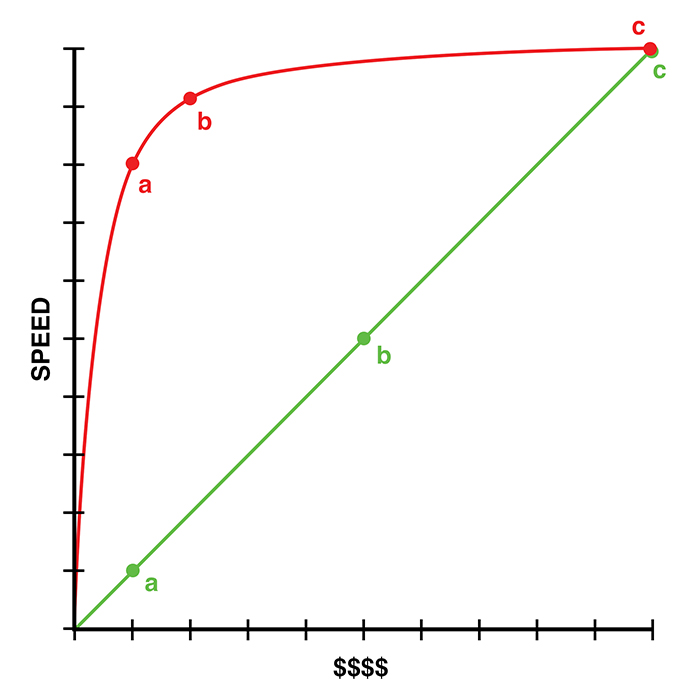
Honestly, I don’t know enough about the sport of motorcycle racing to fact check him, but the figures he recited surprised us. Both Teri and I had assumed that the progression from amateur to professional would be more linear, like the green line on the graph. We assumed that 10% of the cost would give you 10% of the speed, 50% of the cost would give you 50% of the speed, etc. That is, a set amount of effort would result in an equal amount of yield.

It was only later that I realized his progression of speed/cost ($5k, $25k, $100k) was pretty similar to what I had noticed in retouching.

As it happens I am an expert in photoshop, with well over 30 years of professional experience. One of the things I can say with some surety is that anyone can retouch. The Photoshop app is somewhat complex, but retouching with it is not rocket science. You don’t have to have an advanced degree in engineering to use it well. The only thing you really need is experience.
My breakdown on retouching goes something like this: (and yes, I am cribbing from Malcom Gladwell here) 100 hours, 1,000 hours, and 10,000 hours. These are the markers I look for to see how good you are. These numbers are not set in stone by any means. Use them only as a rough guide.

100 Hours
Put 100 hours of work into Photoshop and you will know something like 80% of what you need to be a professional retoucher. You obviously won’t know everything, but 100 hours is enough time to be familiar with most of the main tools, and how they work. Assuming an 8 hour work day, and a 5 day work week, then 100 hours comes out to be just short of 2 weeks. So put in 2 solid weeks of hard work in photoshop, and you’re most of the way to being a professional retoucher.

1,000 Hours
Put 1,000 hours of work into Photoshop and you will know something like 90% of what you need to be a retoucher. Assuming the same rate (8 hour day, 5 day work week) 1,000 hours equals 25 weeks, or about half a year of experience. Half a year is a lot. By then you will have learned most of all the little tricks, have developed a good sense of color matching, and will have learned most of what you need for complex tasks like layer stacking and embedding smart objects.

10,000 Hours
Put 10,000 hours of work into photoshop and there will be very little left I can teach you. In fact, I might be looking over your shoulder seeing what tricks I can learn from you. 10,000 hours is a good, solid five years of effort. Without question, this is a professional level. Honestly, you might be just as good in only 2.5 years, but one of the things I like about the 5 year mark is it’s about that point that you stop making most mistakes. You can know all you need to know before then, but it takes about that long to understand your weaknesses enough to compensate for them. At this point you not only know the work, but you are now looking over your process and tweaking it in little ways to generate slightly better outcomes.

Okay, so that’s a rough scale to follow, but this post isn’t about photoshop or motorcycle racing. It’s about how all types of craft follow this same principle. No matter which art you practice, your progression through it will not be linear, but roughly logarithmic. But (and this is the important part) to those around you, your path will appear to be linear.

There’s two parts to that, so let me deconstruct it a little. The logarithmic path is the way we do art. All of us. It doesn’t matter if we are talking painting, poetry, songwriting, silver-smithing, or quilting, The path to being an expert is the same. It takes about 100 hours to get to know what you’re doing, another 1000 to refine your skills to a fairly sharp point, and roughly 10,000 to pretty much discover every mistake. There are reasons for this progression, but I’m not going to go into them at this time. Again, Malcom Gladwell does a decent job of the topic in his book Outliers (though I wouldn’t believe every word he writes), but there is actual research behind the concept. The numbers are not set in stone, but they make a good rule of thumb. If you’re just learning an art, then this gives you a good idea of what to expect.

And to be clear, there are no shortcuts to this either. I know when you start out doing an art that you want to believe that you have some innate ability which will take you to expertise in less time. I know I do this, and have with every craft I’ve practiced. But the simple truth is, there’s no such thing. Everyone who wants to be an expert needs to put in the hours. Period. When we talk about doing things the hard way, this is what we mean. Yes, it’s difficult. Join the club.

(btw, this is good advice. Do join the club. Be involved with other professionals if you’re practicing a craft that pays well. Their wisdom will help you, and you might just shave a handful of hours under their guidance. But most importantly, you will be around people who are closely aligned to you. This is its own kind of balm. I never have to worry about explaining crazy clients to my other retoucher friends. They all get it. We have a shared emotional experience that is impossible to replicate.)

So back to the topic
This algorithmic progression (100, 1000, 10,000) is roughly the shape of our paths as creative people. But to an outsider these paths will look different. Remember how I said my wife and I were surprised at the cost of a motorcycle compared to its relative performance? This is because we all tend to think of things as being linear. That is, we assume the results should equal the effort. I assume this is just a flaw in human reasoning. I’m not sure of its origin or why we are affected this way, but we are. Perhaps we have an inherited sense of justice, and in a just world 20% effort would equal 20% ability. Thankfully the arts do not work this way. Honestly, most of them are too difficult. If we got relatively poor results early on, then we’d give up. I know I would.

So what this means is that when you put in your 100 hours, your friends and neighbors will look at you and see you are 80-90% of the way to becoming an expert. Naturally, they are going to assume you’re almost there. If 100 hours got you to 80%, then all you need is another 20 more hours and you will have nailed it. Makes sense, right! I mean, that is a linear progression.

The thing is, we’ve all seen this or done this. This part is very normal. Someone you know in high school or a neighbor picked up a pencil in art class and at the end of the semester they could seriously draw. Or they picked up the guitar, or they started singing in choir. It doesn’t matter what art or craft, the results are always the same. 100 hours of serious effort yields a huge amount of ability. And it’s naturally easy to assume success will follow.

But ask any expert in their field and you will get an entirely different response. If someone showed up at my door with 100 hours in photoshop and wanted a job, I would laugh. Someone without any experience at all might look at their abilities and think they’re pretty good, but I would see all of their flaws. This is EXACTLY the situation that every creative goes through when doing their art. This is why I recommend that if you want to be an expert in your art or craft, you work to professional standards. My point here is that those wishing to attain success in their creative field will be measured by the experts, not the amateurs. And believe me, they will have something to say about it.

This is why I believe that overnight success is a myth. First of all, because I’ve yet to see someone who suddenly rocketed to fame that didn’t have 5 or more hard years of experience under their belts. But also because I know what it’s like from the other side. Every professional art or craft is littered with experts, women and men who have done their 10,000 hours (or the equivalent) and know what’s what. Do you think they’re going to let some upstart play with the big boys just because they are cute? Do you think they’re going to go easy on someone else, especially after they had to do it the hard way? Not a chance.

The problem is, you don’t see anyone doing all those years in the arts. Our culture is amazingly blind to this work. Movies are especially bad, compressing any real (and thus boring) work into a montage. Team America even has a hilarious song called Montage that makes fun of this phenomenon. Books are not much better, in part because it’s very hard to express the mind-numbing difficulty of putting in that time. It’s literally something you have to do, and it often feels terrible when going through it. Back when I was a musician there was a common trope that everyone needed to “pay their dues” to be any good. This is the closest I’ve seen to the concept of 10,000 hours being codified in reality. Even then it was a long time ago, and every time I saw the “dues paying” concept it was consistently presented as being wrong, or some kind of gatekeeping. The truth is you often don’t know what you don’t know until you learn it. And it’s almost impossible to teach some things short of experience. That’s not gatekeeping, that’s how the creative process works.

So to wrap this all up, we have this tendency to expect the world to behave in a linear fashion, but the practice of learning any art or craft is actually more logarithmic in nature. It is the difference between our perception and this reality that drives so much confusion, and perpetuates the myth of overnight success.

A few caveats. Probably the most important one is you don’t have to be an expert at every craft. It is totally okay to practice a skill and let it remain a minor one. I have maybe 20 hours of sewing in my whole life, and while I can inexpertly repair a few things, and sew a straight line on a machine, I have no interest in being anything more than this. You not only don’t need to be an expert at everything, but sometimes it’s healthy to intentionally NOT be an expert.

And some skills can sneak up on you. Over the Christmas holiday one of my sisters showed up with a whole bunch of cookies, all of them tasty. This was not a skill I’d noticed in her before. But then I got to thinking, If you only cooked 25 hours a year, starting at the age of 20, by the time you reached 60 you’d have put in a LOT of hours. Well over 1000. That’s enough to make anyone pretty good in the kitchen.

The second caveat is that expertise is not a guarantee for success. In a competitive field like acting, or writing, or music, expertise is often the minimal standard. I know more than one expert who put in the hours and then found it hard to find work. It happens. All that to say you can’t assume x hours somehow = success, only that you are proficient. Sometimes proficiency is all we get.

2025 round up

This is my attempt to keep an annual marker of my progress as a writer. The words are mostly for me, but I put them here so you can follow along as well, if that’s your thing. Much of last year was taken to marketing myself, something I am loathe to do. It’s one of those jobs that are necessary and boring and sometimes makes you feel icky, but no one else can do for you.

In 2025 I wrote:

1 novel. Not a Man to Back Down, which is book 2 in the Speaker for the Dead series. It is just over 100k words in length, and I will be sending it out today for my Beta readers. (if you wish to be a beta reader, send me an email, and I will hook you up).

6 new short stories from scratch. These are stories that were finished in 2025. Some may have been started earlier, but not finished. An additional story that was finished in 2019, and was “held for consideration” this year (but not purchased), I gave a heavy edit this year and then put back into circulation.

At one point in 2025 I had a full dozen stories out trying to find a home in the various places. For most of the year it was nine or ten stories out. Currently, I am down to seven that are out, with at least five that either need to be retired, or wait for the market to open for that type of story. All that to say, I am hustling.

1 story sold. C’mon Boys, a 6,700 word SF short story I wrote in 2024 was published by Baubles From Bones in December. I am still pretty excited about this.

A whole bunch of marketing materials: Bios, Query letters, Synopsis, etc., all in an effort to find a Literary Agent. I don’t know how much I wrote, but it was probably something like 4-5k words.

10 Essays on various topics, much of it related to be creative. All of them posted here.

Earned a whopping 74 rejections for short stories. When you have a lot of stores out, the rejection can come flying fast. Even the story I sold, C’mon Boys, was rejected seven times before it was purchased.

Got turned down by 38 agents for both Speaker for the Dead, and Mind The Slice. This was pretty brutal. I sent out 38 packets and got all of them rejected. To be fair, this was my first time sending query letters. Next time I will switch some things around which should improve my chances slightly, but these changes are all pretty much window dressing. In truth, there are hundreds of thousands of novels written each year. A healthy percent of those novels are queried to agents in an attempt to get someone on the author’s team. My little letters are just one of thousands. Some agencies get hundreds of queries a week. No one can read them all, and make good decisions. Most agents only take on one or two new authors a year, if that. With thousands coming in, and only 1 or 2 going out, the math is not all that great.

This isn’t a complaint, this is a description of the process. Rejection is absolutely a guarantee. It’s also not necessarily meaningful. I mean a truly bad novel and a truly great novel can both be rejected, even if they are rejected for different reasons. And I don’t for a minute think I write great novels. I mean I try, but I’m also still learning.

Started a non fiction book on the nature of culture and stories. Right now it has no title. I’m not even sure of how broad it’s going to be. It’s one of those things that is so complicated I have to write about it to know what I’m writing about. But I’m researching and writing notes, and writing little 1k-2k diatribes that might one day be cobbled together into something meaningful.

2025 was not my most productive year in terms of writing fiction, but it was my most productive year in terms of selling stories and selling myself to an agent. I learned a lot, even if some of it was what not to do.

Read 65 books. I add this number here so you understand that it’s not just writing that I’m doing. There’s a whole lot of reading going on. Sometimes it’s for research, sometimes it’s for pleasure, and sometimes it’s a little of both. The majority of these I got at the library. I track everything I read now with an app called Reading List. I also use it to write little reviews of what I’ve read, mostly to remind myself of the story and what I got from it.

So you want to be an artist

Unsolicited advice on how to make it in the creative world, from someone who has been in the trenches for a while.

Many years ago I had a job as a delivery driver for a rental company. This was back when I was around 19 or 20. By then I had completed exactly one year of college before dropping out to play in a Christian rock band. The Christian part was new, but the musician part was not. (spoiler alert: I’d eventually fail at both). 

Music was the first art form I’d tried that I could unselfconsciously immerse myself in. Oh, I’d been doodling since elementary school, but I could never draw uncritically. I was always finding fault with my work. It was never good enough. Besides, I never saw myself as an artist. My mom was an artist and taught art, so I had a pretty clear idea about that path, and I was sure it wasn’t for me (spoiler alert: I’ve been a professional artist for over 30 years now). The important part here being I could see myself as a rock musician. The music wasn’t that hard, and the rewards (money, fame, girls, and drugs) all were enticing. It was a future I could embrace. It was my shortcut to success and adulthood.

Besides, music was fun to play.

All I had to do was try hard, and eventually I would succeed. Someone would notice my drive, my earnestness, and pick me from the crowd. Then my life would be nothing but limousines and pretty girls, and no more cares about money.

And why not? This pattern had always worked for me before. I was quirky, which meant I had that perfect blend of creative and smart. Teachers for the most part liked me. I was exciting to have in a classroom. I was surprising (in a good way). I had potential. The way I figured, if I was always going to be somebody, I might as well be the somebody I wanted, and right then I wanted to be a rock star.

And I REALLY WANTED IT. I was an unknown kid from a shit little town, struggling (and failing) to remain middle class. I had all the desire you could want. I NEEDED it with a white hot WANT, and I wasn’t going to settle. I was going to have it all.

Somewhere along the way I also became a Christian, but this was not an impediment to my musical success. Quite the opposite. I’d been listening to Christian music, and realized there was a dearth of good rock songs about God. Most of it was pretty tame in comparison to the secular rock I’d loved so much.

So I went for it.

It was somewhere during that time that I worked for this rental place. The job, as I told everyone in ear shot, was only a stepping stone. Success, real success (meaning rock star fame and fortune) was just around the corner. Sure it was the Christian version of rock star, so less drugs and more earnestness, but I was good at being earnest. So it was no surprise that on a slow day I pulled out my guitar to practice in the back. 

The boss had recently hired a new guy named Steve. (I’m sad to say I forget his name, so I’ll call him Steve) Steve was a little older, and probably a lot wiser, but we got along okay. He worked up front with the customers (something I didn’t do well), and I drove delivery. Still, we were close enough that when he heard me practicing, he came walking to the room, past all the half assembled lawn mowers and dirty dishes, wearing an expression in his face like he was close to tears. Then as he approached he got down on his knees in front of me, clasped his hand together as if in prayer, proceeded to blubber. 

For those of you who grew up in the church, he was mimicking an altar call. For those who didn’t earn their merit badge in exuberant protestantism, he was faking the spiritual ecstasy of someone about to have a conversion experience. Mind you, I knew he was being funny, I even knew he was being funny at my expense, I just didn’t understand why. I laughed, because it was funny, but I didn’t get what he was doing. Why was he making fun of me in that way?

I know now it was because I was exuding desperation and earnestness like a bad cologne. Exuding it so hard it made everyone around me uncomfortable. I was practically screaming my want to the world.

And it wasn’t enough.

Many years later, I was living in another town (Los Angeles) and working in another industry (entertainment advertising). By then I was a professional, earning a professional wage. I even had my own office. I worked for a small division of a slightly larger company. I had also met Teri by then and was either engaged or about to be engaged. Basically I was in my mid 30s, and settling down. I was also having a kind of crisis. 

See, at the time I was a finisher, which is the last person to touch a piece of art (like a movie poster) before it is printed. My job was to take designs that had been put together with more speed than skill, and make them into a cohesive piece of art. Finishing is a job that is more technical than creative. The big design ideas have already been worked out. Your job is to make sure all the fiddly bits, all the small details, work together. 

My problem was, I didn’t find the work creative enough. 

Most of the people I worked with were finishers like me. We’d come into the business from the technical side. None of us had gone to art school. None of us were deeply creative (or creative as I saw it then). So when we got a new boss for our division, one who was both an outstanding Illustrator and a photographer, I took him aside one day and asked him how one got to be a designer. 

His name was Michael Elins, and while his advice was a little mixed (he’s a much better visual artist than a writer), and full of exacerbation with me, (he must have thought my question was like asking a fish why they liked water) still, his words have stuck with me to this day. What he told me was that a designer didn’t just do designs. They got design magazines, they went to art shows, they made friends with other designers, they worked at design agencies. It wasn’t just a job, it was a whole experience.

The feeling I got from him was design was a kind of lifestyle. As if design was something one did, like being gay, or being a banker. It was a whole package.

This was a lot closer to the truth than Steve’s display at the rental place. But it took me a few more years to have both of them make sense.

Basically, what I think Michael was hinting at was that an artist first and foremost does art. That is, they do the work of being an artist. This is not unlike something that authors often say: A writer writes, or a painter paints. The main point being, it is not enough to want to be something like a designer or a rock star. You have to do the work. 

The key is not desire. You can have all the desire in the world and still not succeed. The key is in the work. It’s not enough to grow out your hair, or pierce your ear, or say all the right words. 

The thing is, much of the world doesn’t work this way. To be a Christian all you have to do is say you are. The same is true for most jobs that are considered unskilled. No one is going to check to see if you are really a dishwasher or a waiter. Sure there are limits to what you can say about yourself, but for much of the world, especially much of the middle class world, “fake it til you make it” is a tried and true recipe for success. 

It just doesn’t work in the creative world.

About a month ago, a very successful author posted something on FaceBook  about “being” an author. They were giving the tried and true advice I included above: A writer writes. Many of the replies showed that the other fans of this author were not “getting it”. They were under the impression that if you had a good enough idea, or sufficient raw talent, then that was enough. 

I don’t blame them, it took me decades to work this out, mostly by failing, over and over.  So allow me to save you that failure if I may.

The reality is this: If you want to make a living in a creative field you’re going to be facing a long uphill battle. I promise you, it will be a slog. There are three major reasons for this.

The first is about the numbers.
The truth is there’s a lot more people who want to do the work than there is money, and there’s not a lot of money. Sure there are success stories, but these people are vanishingly rare. For every Stephen King or Elton John there are tens of thousands of people who you will never know doing the exact same work for next to nothing.

Because of this, to succeed, even at a modest level, means you have to find a way to separate yourself from the pack. It very much is a competition. To be better you need to do more than just want to be successful. After all, everyone else also wants to be successful, and some of them surely want it more than you. Really wanting something is just the floor, not the ceiling. It’s the minimum standard.

Sure, there is a component of luck to this as well, but luck will only take you so far.

The second is about the process.
You don’t get good at any craft (be it writing, or painting, designing, or playing an instrument) by doing it once a week or once a month. You have to do it over and over, hour after hour, year after year. You have to practice it until your fingers bleed and your hopes turn sour. You have to practice until you reach the point that you are sure no one else in the world is going to care, and then you have to practice some more.

The value of art is in the doing, not the thinking. You can have a million dollar idea for a movie or a novel, but until you do the work of making that idea a reality – something you can hold in your hands or show to others – it’s not worth two cents. Art without action is nothing. Ideas, like desire, are just the floor, not the ceiling. You need something else.

The third is about standards.
It’s not enough to do the work, you have to do it well. You have to be demanding of your creative output. You have to hold it to the white hot fire of criticism, and burn off all the bad parts. You have to develop a critical eye. You have to be willing to be discontent. You have to suck, over and over until your work starts to suck less; until you reach the point where you stop making the obvious mistakes and start making the subtle yet challenging real mistakes, and then start all over again.

This is the point Michael Elins was trying to convey to me all those years ago. Good designers are always comparing their work to other designers, usually the very best, and then working hard to perform at that level. They talk to other professionals in their field, they notice all the work that is being done, and they are fucking critical about it. Most importantly, they are critical of their own work.

The thing is, this part is hard, perhaps the hardest. Just having the ego to think that you can create, that your ideas are important, that something living only in your head needs to be in the outside world, is super difficult. Especially, if no one else in the world gives a damn. Sure, you can surround yourself with others who care. I was in several bands when I was a musician, but even that wasn’t enough. The enemy is always the person you face in the mirror. If you shit too much on your own work, if you are too critical, you can shoot yourself down and keep yourself from creating. If you are not critical enough then you can go on for years being mediocre and never understanding why you’re not finding success. It’s a very fine balance, and it is always changing.

And even then, even if you do all three of the things I mentioned above, your success is not guaranteed. You can go your whole life and only those close to you will see your efforts. Look up Larry Todd, of Aline Kominsky-Crumb. There are famous painters like Van Gogh, Cézanne, Monet, and Gauguin, who died before they became popular. Even authors like Sylvia Plath, Henry David Thoreau, Emily Dickinson, John Keats, Edgar Allen Poe, even fucking Herman Melville, all gained notoriety after they passed this earthly veil.

You can have all the desire in the world, you can do the work, and you can do the work at a very high level, and still not find success. That is the size of the mountain you are facing. All of us creative types face this, and yes it is fucking daunting.

But also, who cares? So what if it is hard? Everything is hard, everything is difficult. Just getting out of bed some days is too much. Don’t let the size of the thing fool you. It’s mostly in your head anyway.

Knowing all that, if you still want to be an artist here’s my advice:
First of all, if you want to be something, then be it. Don’t wait for someone else to give you permission. If you want to be a novelist, then write a novel. If you want to be a musician, then play your heart out. If you want to be the best chef in all of America, then start cooking up your own recipes. 

Don’t wait on desire, do the work.

If you want to make money at your passion, if you want your passion to be more than just a side hustle, then you need to not only do the work but mix it up with the big boys. That means you need to be critical of your art, you need to refine it, edit it, make it better. You need to make it the best you can, and then you need to find a way to make it better. This is a journey, and it is NOT going to happen overnight. Developing a critical eye for your shit takes time. This is why there is no such thing as an overnight success, because becoming a professional takes hundreds or even thousands of hours of patience and dedication. They don’t pass that out at the corner. If they did then everyone you know would be a success. 

Perhaps most important, if you tried to do something creative but didn’t have the wherewithal to take it to the top, DO NOT LOWER YOUR HEAD. Keep your chin up. You braved more than most. Failure is not a failure unless you decide not to learn from it, so learn. Maybe you’ll learn (like I did with music) that it’s just not an art for you. Maybe you’ll learn you just needed a break to let things settle down, before you start again. Maybe you’ll learn that it sucks and the big boys cheat (they do), and the work is totally unfuckingfun (it is).

Being a creative means taking it on the chin. Always. There is no path forward that doesn’t come with pain. Easy street is for suckers, not for us. Sometimes the only way to tell that you’re on the right path is when the blows come hard and fast and you keep going anyway.

But also, there is no shame in bowing out either. This is your life, you get to create it anyway you like. In fact, your life is your best creation. If you step down a path that gets too weird or too dark, it’s totally okay to walk away. Only you can set your standards, and only you are responsible to them. No one else should have that power over your passion, so don’t give it to them.

Bottom Line:
If you want to live, (not succeed, but live);
if you want to be happy (not content, but happy);
then you have to find joy in the work.

Find joy in what you do. Find joy in what you create. Find joy in the creative process. It could very well be the only happiness you will get from your passion, so celebrate it. Make the most of it. In the end, this is the only thing you are guaranteed.

In defense of the book market

David Brooks has just opined on the state of the literary world in a a piece called When Novels Mattered. I stumbled upon it in my facebook feed and responded there. I copied that post here so I could expand a bit on my thoughts.

First of all, David Brooks is a nice man I’m sure, but he’s a columnist at a major newspaper which means he needs to crank out a couple thousand words a week to pay the rent. He’s also a conservative, which means he has a few axes to grind, which he will reliably pull out in almost every column.

In this one we learn literary fiction has taken a blow, in part due technology, and in part due to Liberal groupthink. All of this is pure horseshit. David is a nice guy, but he’s not paid to think far outside of his few check boxes, and it shows. He’s not alone. A lot of people are like this, taking in the world as it appears, and not asking themselves if any of the things they are told are true.

The past month or so I have been digging into the literary world more than normal. Mind you, I’m trying to turn a side hustle-writing fiction-into a low key cash flow, so I have a few cards on the table. One of things I discovered was a bit of the lamenting in the literary world over the loss of the male writer. There is even a shop in the U.K. talking about publishing only male authors. There in fact used to be big bold men, who also happened to be literary darlings, and their voices drove a lot of interest and/or book sales. Their cultural value was indeed immense, but they also existed in a much different literary market, one that was much smaller, and also male focused.

But dig me now, EVERYTHING used to be like that.

There used to be more gate keepers, and less novels. This is a fact. Our culture had fewer voices to aggragate around, and most of them were male. Genre fiction was relegated to a much small piece of the book publishing pie, and woman writers were rare. Popular women writers were very rare. This also happened to be the same time that we had only four television networks, with only a few slowly expanding cable channels as competition. Culture was constrained back then, not by desire but by technology. There simply was no easy way to find books outside of the ones pushed by publishers. You got what they sold you, and what they sold you was bold male voices.

I know we like to think of our favorite cultural amusements as being significant, but in a capitalist society like ours, every cultural item you find is actually a commodity packaged and sold just as much as the food in your grocery cart. Books, television, movies, computers games, all of them are products which are packaged and sold.

What the internet has done was flip the script in terms of selling products. In today’s world you can actually seek out books that appeal to you. They are not just handed down from the big publishers. This means more voices are being published, over more genres than ever before. More books are being published as well, not just by the big five publishers, but by a huge amount of self-publishers. Among other things, this means that the current market is much more reflective of the choices of the buying public, and much less reflective of what book publishers want to sell.

Books are not the only art form affected by the internet. Music has radically shifted (there are many more bands selling much more music, in expanding genres, with the average income dropping, and fewer rich musicians), so has movies, television, and video games. That is to say the medium in which we consume art has made the process far more individualized and idiosyncratic. It used to be you were stuck with Norman Mailer because that was all everyone was talking about. Now if you roam the literary web for long you are going to be bombarded by hundreds of voices, each of them telling you how great their favorite books are, and each of their picks will be different.

For years there have been more women readers than men. Now there are also more women writers than men. There are reasons for both of these trends, but they are facts. This is the current market. My reading of the room is that woman’s voices appeal to women readers. They don’t need literary bad boys, telling them about themselves and the world. They need voices more like their own, with solutions more like what they know works. Hence the trend towards mixed genres like Romantasy, cozy mysteries, and solar punk. All of them are essentially taking a page from romance and woman’s books, by removing much of the gunpowder and violence, and replacing it with complicated and “community” solutions into their plots.

I stumbled upon this when I began the process of trying to find a literary agent. Since the beginning of the year I have read hundreds of different agents “wish lists” trying to find one who might be interested in my work. This is a very bizarre lens with which to view the literary world, but it does offer some perspective. I can tell you that literary agents are almost exclusively women. The ratio is at least 10 to 1, but probably higher. To a woman, they are looking for strong literary voices that jump off the page. I’ve read variations on that phrase so often that I can recite it in my sleep. The people who make a living selling authors to publishers all want to back a horse that can win the literary tripple crown. If there are writers like that out there, you can be assured they will find them. This tells me that the actual people who can who can write in a bold new voice are exceedingly rare, but also I think the value for such a voices are much lower.

Look at the books that are selling. Look at the genres that are expanding. This is where readers tastes are going. These are the books that readers are reading. Reading still has a huge cultural value, literature is still hugely paramount. There are things that cannot be said in long form fiction outside of a novel. Right now that means more books are being written about the black experience, the lgbtq+ experience, and largest of all, the female experience. This is what is selling, and it’s leaving a mark on our culture.

If you’re a man, and used to having white, CIS male, voices being centered in your culture, you’re going to see the world like David Brooks does. It will feel like a loss, even though white CIS male writers still dominate the cash flow. If you’re interested in hearing marginalized voices finally getting their say, then you’re in luck, because for the first time in recorded history that is happening right now. Regardless of what you think about the merits of these voices, it is a marvelous thing that it can happen.

From my experience, I would say that we’re in the middle of a renaissance in literature. There has never been a bigger table with more flavors. There are just less big platters, and more smaller bowls. You can still only eat so much, only now there are far more choices.

Culture, an Analogy

“The ultimate hidden truth of the world is that it is something that we make, and could just as easily make differently…” – David Graeber 

Many years ago I had a sort of epiphany about what culture is, and how it works. At the time I chose to not write it down, in part due to my own laziness, and in part to see if it was a genuinely good idea. I often have ideas that fail to make it the full light of day before imploding. Such is the nature of creativity. The impulse is kind, but its offspring are not always lasting or well-thought. 

Over the years my little analogy grew to reflect changes in the outside world. I saw arguments in politics over the culture wars (which, far from being a recent phenomena, dates back to the beginnings of recorded history), I saw massive changes in the media that artists use (from vinyl to CDs, from DVDs to streaming, and from AOL to the targeted social media we have today), and I saw every day recommendations (over books or screen time, or the value of letting a child play outdoors), and they all struck me as somehow being connected.

The question remained: How? How are these seemingly disparate elements connected? My answer is the stone.

The evidence for my analogy comes mostly in the form of observation. I have no formal education into the nature of culture, and in fact have barely scratched the surface in terms of research. All of what you read comes from a simple yet central idea. What if all the things that humanity argues about were just variations on the same thing? What if this thing was something that grew over time, evolved as it were. Ideas battling it out with other ideas until eventually one was the victor. After all, we no longer argue over the divine right of kings, or assume that mental illness comes about from demon possession. Why is that? What made those changes happen? It was cultural, sure, but how? How does culture work? How does it evolve? 

It was in attempting to answer those questions that this analogy came into being.

The Stone

Imagine if you will, a massive wheel of stone that is hundreds of miles wide and perhaps equally as large in diameter. The stone travels slowly over a large flat plain, completing a single revolution once per year, so that the part which is currently at the very top will be on the top again in precisely 365 days. The weight of this stone is crushing, destroying everything in its path. Behind it is a transformed landscape marking its passage that goes back for millennia. The stone is almost inconceivably large, and is unstoppable in its rotation. 

Upon the face of this stone are people. We will call them sculptors, though they go by many different names: Artists, writers, painters, dancers, singers, songwriters, chefs, architects, musicians, scientists, etc. They are of all shape, sizes, color, nationality, and religion. Each day these sculptors work upon the surface of the stone, battering and hammering into the hard face with their tools. Their goal is to affect the stone in such a way that when it reaches soil below it will use its massive weight to stamp an impression into the dirt that will last year after year beyond its passage. Some sculptors work singularly, some work in large groups. The work is hot, heavy, and dangerous. The very top is the safest place to work, and that is where you’ll find most of the sculptors, but the stone remains underneath that area for only a short time. Those that wish to influence a particular section beyond that short moment, must invent ropes and pulleys and other contraptions to hold themselves to the ever rotating surface while they work. If you start too early you’ll discover that the stone, fresh from compacting the soil, is embedded in a thick layer of dirt. If you stay too late upon the other side you risk the very real chance of being crushed by your own work. Every year the stone in its undying rotation creates hundreds if not thousands of casualties. The price for inattention is high.

All of humanity is deeply interested in what the sculptors do, but the vast majority do not live upon the stone. Either they find the work disinteresting, too dangerous, or perhaps they have some other reason. Instead, most people live in the impressions left behind by the passage of the stone, for as the stone moves it leaves behind vast buildings made of compressed soil, some so large they become massive unending cities. Also left behind are sculptures, and trees, comfortably shaded benches to sit upon, toys for children and adults, pools, and roads, auditoriums, and churches, and cathedrals, cars and trains, musical instruments of every style, and vast platforms that twist and swirl for dancers to perform upon.  All that is needed is a little bit of scrubbing, and a little bit of digging, and the impressions from the stone can be made livable. Don’t like the house you’re in? Wait a year and try the next version. Hopefully, the architect up on the stone will listen to your requests. Of course, you can always pay them, for many of the sculptors are paid by the people below to create things for their use. Not all sculptors are paid. Some work for the joy, or desire. Some for the notoriety. It is said that one sculptor, by the name of Jesus, hit a crack in the face at just the right moment that it caused a massive avalanche of stone to fall. You can still see the impression of his work today. Some claim this Jesus was buried in the rubble of his own creation, and popped up, alive and healthy, three days later on the other side. His own work sheltering him from the weight of the stone. Alas, no one can travel back that far in the stone’s wake and check. 

This, then, is our culture. The stone. It is both something that concerns us all, and yet is something we can also contribute to. It is the most democratic of mediums, although some groups do in fact limit who among them can work its surface. Some people by hammering away find great success, but the vast majority of sculptors do not. Most know of the stone only by the impression it leaves behind. Some live so far from the stone that they have never seen its motion. By now, the entire surface of the stone has been marked by humanity, much of it for thousands of rotations. That doesn’t mean one cannot go in and try to reshape any area they desire, but the stone is hard, and the work is difficult, and there might be just as many sculptors wishing to carve the stone in the entirely opposite direction. The battle is the work, and the work is the battle, and all of us, all of humanity, are affected by the outcome. 

Deep in Rewrite land

I’ve been deconstructing the first part of Mind The Slice, which is a slow and deliberative process. Part of it is replacing the first several chapters of the novel, starting it closer to the core action.
Lilah, of course, as opinions on this. I thought it would be fun to write a prologue in her voice, and she really ran with the ball. I don’t know if this is going to make the final cut, but I love how she has no fucks to give.


Prologue

Someone told me once what a prologue was. Honestly, at first I thought they were joking. Like why the fuck do you need to write about a story before the story? That’s just dumb. Can’t you just write it right to begin with?

But then they explained it was more about voice, and tone, and I was all, “Voice? Oh honey, I got this one.”

So here’s my fucking prologue.

None of you know what its like to be me. None of you. You think you know what the world is like, sitting there is your safe little houses with plenty of food to eat, and nothing to worry about. Do you know what its like to not eat for a week? Do you know what it’s like to hear the sound of helicopters and know down to your bones that someone around you is going to die? Do you know what its like to sleep out in the cold without blankets or coats because your house just got bombed, and all your belongings are buried under tons of concrete?

See, I know what your world is like. I lived in it too, up until your President decided that people like me couldn’t be trusted, and kicked my family out. I’ve been to your schools, shopped in your malls, I’ve seen your Christmas lights, I’ve gone trick-or-treating, I’ve been to your national parks. I was there, I had it all, I thought it was mine as well, but then it was taken from me, swapped for a country in the middle of a civil war, and all because my family worshiped Allah. 

I know what it’s like to be you, but you don’t know what it’s like to be me.

Did you think I started to hack for fun? Oh no. I turned to crime because there was nothing left for me to do. You saw to that. You and your people. So don’t go giving me that bullshit about being a criminal. YOU MADE ME ONE. I would have been happy pretending like I was one of you, but you decided that wasn’t enough. You’re the ones that made sure I couldn’t join your little club, so don’t go fucking crying to me when you have to hear what I have to say. You sent me down this path, mother fuckers. You made me what I am.

The only time you think about people like me is when you bomb us. And yes, you totally fucking bomb us. Don’t think we don’t know? Are you so lost in your own special world to not realize you paint your names and serial numbers on the outside of your ordinance? Sure, some of the bombs come from Russia, and even some from North Korea or even Iran, but we can read that shit too. Like you’re the only ones with access to goggle translate.

Discounts, discounts, everyone over there is looking for a discount. Well let me tell you something, dis-count, this count. I count too. 

I have dreams, I have desires, I am going to write my own path, and you cheap-assed mother fuckers are not getting in my way. I will go behind you, or over you, or around you, or THROUGH you, but you are not going to stop me. No sir. Not no more. I’ve had enough of your set backs. I am moving forward, and you ain’t gonna slow my roll. I am miles above, beyond you, inside you. You cannot stop me because I am in you. I have hacked into your systems, I am deep inside your code. You can’t get to me without first getting to yourself, and you can’t handle that. You can’t deal with your own criminal ways. You don’t want to hear it.

You hate me because I force you to deal with your own shit, and you cannot stand that.

But don’t you worry about me none. I’m gonna be just fine. You wanna know why? Just like you can’t deal with your shit, you also cannot stay mad at yourself either. There always another meal to eat, another tv show watch, another discount to buy at your stores, until you bury yourself so much cheap crap that you don’t hear our screams.

Well guess what, mother fuckers? Someone gave me a microphone, and you’re gonna hear me now, because I am LOUD.

From the Writing Desk

Work on my next novel “Fight From The Inside” (aka Mind The Slice 2) is moving along at a healthy pace. This is how my work ended yesterday.

Note: this is slightly spoilery for MTS, and is entirely unedited. The person speaking, Amethyst, is looking over the data from something that happened near the very end of MTS, and they are NOT happy.

Here it is:

And then there was the data from the Gap Sampler. Apparently one of the two impossible pair-bounds had destroyed the device, and all the data within it. This was bad as the connection data from the machine would have been highly valuable in terms of verifying how tight they connected to each as, and how well they thought.

As it stood, Amethyst wasn’t even sure which half of the pair had destroyed the machine. Whoever they were, they had been quite thorough, going so far as to remove the delicate data cartridges from the Gap Sampler and atomizing them using a large piece of solidified quartz. Amethyst has seen the photos. It was an impressive amount of destruction, almost as if they had been trained to cover their tracks. 

The last half of that last sentence in interesting. It was a total surprise. I hadn’t even had that thought, right up until I typed it. And then, oh boy, the implications: This, ladies and gentlemen, is what you call a plot point, seen in it’s natural wild state. I’m going to have a lot of fun letting Amethyst chase it down. They will too.

Story idea from a Dream

I had this idea in a dream a year ago. Had to look it up that morning to see if it was real. Sadly it wasn’t, though the origins of ventriloquism are disturbingly similar to this.

Still I have a universe I can probably tuck something like this into.

Faux Wiki

American Ventriloquism

American Ventriloquism was a rude style of entertainment started on the western edges of the US in the mid 1800s. Early practitioners were reported to make burping and other crude noises, that were thought to be funny, interpreting these sounds as human speech. This lead to small acts to toured in local areas. The humor was rough spun, some claim intentionally so. Men would pretend their stomachs were speaking, or that their belches and gurgles were their friends telling a story.

John Flannery of Stockton became the most famous of this style of ventriloquist, traveling up and down the state of California in the late 1860s with a small keg named Louis that was painted with a human face.

Reports of this style of entertainment last into the late 1870s before they were eventually overcome by entertainment groups traveling from the east coast on the newly developed railroads.

Must be a good night for dreams for me because 6 years ago I posted on facebook this idea:

I dreamed last night that a strange disease afflicted a group of astronomers, slowly turning their bodies to ice cream. By chance, a sample of one of these scientists, carefully kept in a freezer, was consumed by a young girl who became pregnant and gave birth to the most prominent scientist of our age.

2023

Well I guess we’re at the start of a new year. If I sound uncertain it’s because picking a random day to be the start/end point of a year seems highly suspicious to me. I mean why December 31st and January 1st? It would make more sense to start the year on an actual astronomical marker like the winter solstice (or the summer one for that matter). I would even settle on something like either equinox. It’s not like people haven’t known how to find these particular days, regardless of how their calendar is constructed. It’s pretty obvious once you start looking, and our distant ancestors had nothing to do but look around.

I generally don’t do new years resolutions, figuring that if something is important enough to make a promise to yourself, then start that shit right away. No need to wait for a special day. Want to be kinder to animals, or tell your significant other they are important to you in a meaningful way? Then for Bog’s sake don’t fuck around about it. Do it now. All that to say don’t expect wisdom from me, except to point out the excellent resolution from a colleague of mine who every year resolved, “if someone offers me a donut, I will take it.” That still strikes me as good advice.

On a different note, I’ve been working on a novel titled “Mind the Slice” for a few years now. The darn thing should have been finished long ago. I would write and write, but for some reason I could not hit the dismount. In truth, the story would get bogged down on some minor point, and then I’d lose my nerve. To compensate, I would then spend days and days researching ways to plot a novel. Believe me, there is a lot of “helpful,” and not so helpful advice out there on the internet. All of which is fun to follow if one is feeling lost, but its not necessarily useful in terms of finishing a story.

For me, short stories are much easier to write because they are much easier to plot. You have clear beginning, middle, and end points, and I can hold all the salient parts in my head as I go. But once a story gets to a certain length then I lose that ability to keep it all up in my mind at once. Then I keep having to go back and look, writing myself little notes, like, “Kill the boy after she kisses him, not before.” That kind of thing. And all of that made me feel uncomfortable, like I am missing something, and once that kind of doubt creeps into your head, it’s hard to finish.

Because of this I have like four different starts to the novel, and a whole host of middle passages, much of which I need to prune. That shit is also hard. Some of the plot points that will not make the final cut are still glorious in their own way. They exist as a reminder that yes I can write, and no, not everything I write fits the goal.

Anyway, at some point near the end of last year I had a kind of epiphany, and figured out a passage through the muck. Since then I have been stitching my Frankenstein of a book together chapter by chapter. I am at the halfway point in terms of chapters and such, and much of the second half is already written. I just need to put it all together, and smooth out the transitions. That is the good news. There’s a good chance I will have something in a useful form by the end of this month, ready to send out to beta readers. The bad news is it looks to one longish, like 200k words or 400 pages.

I am so excited. I cannot wait to share this novel. Lilah Al-Marwin is a marvel of a young girl. She is so bad ass it makes me cry. She is smart, and laser focused, but also carries several dark secrets, including her other half. There’s the tall and handsome second son of an Earl named Aberdeen (who has his own secret). There’s Randal, the only child of a billionaire computer maker, who also has his own secrets. And finally there’s Wyoming Johnston, the child of the Senate Majority leader, who also happens to be politically ambitious, while somehow remaining both kind and human (and no secrets). All of them are delightful in their own way, and maybe a few of them get kissed, before they get killed. There is for sure more than one death.

Did I mention there’s a school taught by aliens from outer space? How about an overweight dolphin that teaches alien empathy, or the strange two-part creature that teaches programming and informs the students, “We are not an I, we are a we.” There’s even a mysterious captain, an Electronic Intelligence (who runs most of the show), and an alien who is both covered in strips of plastic, and yet is amazingly sexy. Each of them have their own secrets.

But that not all. The Earth has its own secrets, and those secrets might cause the planet to break into millions of pieces, which would be bad for everyone.

There’s love, and death, and destruction, and earthquakes. Computer get hacked, the planet gets cut in two, and teens get kissed. There’s amazing new alien tech, an end to our climate crises, and maybe even someone saves the planet. That is before they get blamed for everything that goes wrong, because you gotta know, things go wrong in this novel.

It starts with an explosion and ends with a scream. What more do you need?