The thing about the Sequoias.

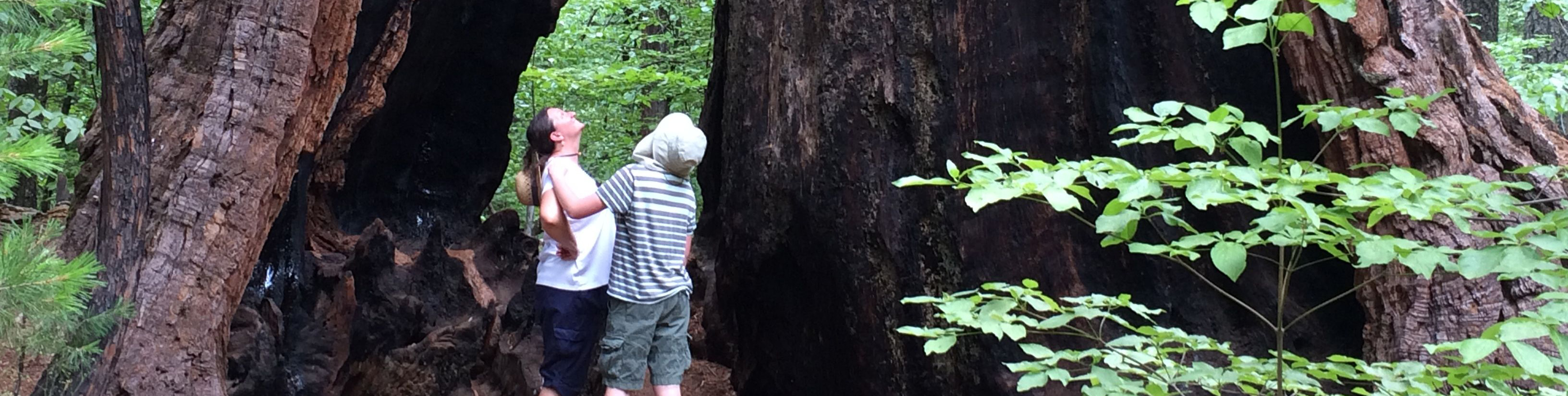
IMG_4693_cropThe thing about the Sequoias, or why you cannot photograph the Sequoiadendron giganteum.


Recently my family and I spent a delightful few days of vacation in California’s gold country in the foothills of the Sierra Nevadas. While there we took a day trip up to Calaveras Big Trees State Park where we hiked the less visited South Grove trail. Thanks to some intense activism this grove of Giant Sequoias is entirely unlogged and remains largely in its wild state. It is, with the exception of the trail and a few signs, almost exactly like hiking in a virgin forrest. I’ve been lucky to spend a lot of time in the Sierras, but this grove is to my knowledge singular. What follows is my attempt to capture the experience of hiking the trail in words. I highly recommend you do not take me at my word, that you do not believe what I have written here. Rather I would prefer you hike the trail for yourself.

As you wander down the trail, the low woods, mostly dogwood and small pines, keep your horizons close. There are a large amounts of dead trees scattered about the forrest floor and plenty of new ones working their way up from the decaying material. The ferns and bushes dot the ground, but do not fully cover it. The whole effect is one of a forest that grows no more than three meters above the ground. It’s not unlike walking through a neighbor’s garden that has been left unattended for years until it’s shape has pushed past any human convention into a wonderful random jumble.

 IMG_4638
No sooner than you seen this, you start to notice that this “garden” is underpinned by dark vertical columns. These are the mature pines, sugar pine and ponderosa mostly, with the occasional lodgepole pine added for splash. In about equal measure with these pines are the cedars which grow in clumps like nurseries with large parents overlooking tiny rivers of baby trees, most of them shorter than a man.
 __
So now your view becomes used to these columns shooting darkly upwards through the light green forest floor. As your eye traces their vertical lines upwards you notice they branch out at around three meters and point their way upwards in long thin triangles. The tops, some of them 200 feet or more above your head, can be seen only from a distance. But these are not unfamiliar trees. These are the taller more wild cousins of the Christmas trees that have been decorating our homes every winter for millennia. We know these trees, we live with them for a few weeks to a month every year. True they are quite a bit larger than the ones in ours houses, but they are essentially scaled up versions of what we know. Scaled up the way 100 tables at a wedding reception are not all that different from the single table you use at home. It is simply more of the same.
  __
But then, as you wind your way along the trail, you start to see still larger shapes looming out of the forest floor. At first they look like normal trees, but then as you approach them they start to get wider and wider until your mind is so startled by the impossibility of a tree at those dimensions that it forces you to pay attention. These are trees so large they trigger that part of our brain we use to warn us of an incoming threat. Trees that are so large they literally scare you into seeing them. You’ve now arrived at the Giant Sequoias.
 __

IMG_4690

Approaching

IMG_4691

Closer still

IMG_4692

Getting bigger

IMG_4693

Holy Cow!

When you get up close to one, you notice a Giant Sequoia doesn’t look like the other trees. They stand like some weird alien creature that has been imported to the forest. They resemble the other pines pretty much the same way that an elephant covered in fur could be mistaken for a wolf.
  __
These trees are so large that you cannot fit them into a single photograph. They simply will not fit. If you shoot one up close all you get is a trunk. These shots look just like a regular tree only shot much closer. If you add a human in front for a sense of scale the tree takes on the appearance of an amusement park model. Its so large it looks more like architecture than nature. If you point your camera upwards then the top will be hidden behind the bottom branches (some of which are as large as entire trees nearby). If you step back far enough to capture the entire height then the sequoia resembles an ordinary large tree, reducing the apparent height of the huge pines around it to the size of seedlings. If you add humans to this shot they appear too distant for the eye to scale, or they’ll be so small as to not matter. Another pixel lost in a sea of pixels.
  __


IMG_4715

IMG_4716

IMG_4718

IMG_4706


No matter how far back you get or what lens you use, you cannot capture a Sequoia in a single shot. They are so large they can only be pieced together by the mind of the observer. Its about then that you discover they’re not as much a tree as they are living geology. To stand next to one as it extends upward into the heavens at that impossible height is to stand next to a million years. It’s not a thing. It’s too big for that. It’s a living metaphor. It’s a rock wall that lives and breathes. It is a battleship made of living wood, set adrift in a remote and arid sea.
  __
As you come across them on the trail, sometimes alone surrounded by a coterie of lesser trees, sometimes in dense clumps of two or three, you start to run out of superlatives. Each tree as it is revealed to you is so impossible that you simply run out of words. As with photography, these trees are so huge you cannot capture them language. They will not fit within a single sentence. And after a few tries you realize even whole paragraphs won’t do. Finally you get to the point were all you can do is stand at the base of such a tree and stare upwards in mute and lensless wonder. Every attempt you make to describe these trees will fail. They simply can not scale down to human size. Even a holiday as large as Christmas cannot contain them.
  __
No wonder the first white men who saw the Giant Sequoias were not believed. They had to cut one down to prove they existed, and then they tried to cut the rest down because trees that large are a threat. They’re too big. They don’t fit our mechanized world. They’re not just tremendously old, they are time itself. Many of them were born long before Jesus walked this earth, and they come from a race as ancient at the dinosaurs. You can beat against one with your fists a thousand times and they will not notice. They are too old, too indifferent. No wonder we chopped them down. These trees don’t know we exist. Nothing makes a white man’s blood boil faster than irrelevance.
  __
Finally, this is what you take with you as you walk out of the forest with a camera full of impossible photos that no one will believe; your irrelevance. You have gazed upon a thousand years. Everything you do in this life will be as nothing to these giant creatures. Short of destroying one, you will never gain their notice, and you will never find their approval even if you searched a thousand years. Such a thing does not exist. You are irrelevant. You are nothing. You are a part of the great and beautiful forest we call life, but you are not the biggest part, nor the most important.
  __
And in the end this is what the Giant Sequoia teaches us; our rightful place.

IMG_4749

Bad Writing Advice #1 On setting goals for your characters

Rule #1 in a non-existent series of bad advice for writers.

When you (as a writer) introduce a character to a reader, it is like introducing them to a new friend. But that character won’t really become your reader’s friend until you give that character a goal. Once you give him or her a specific goal to direct their actions–they need to avenge their father, they need to kill a monstrous whale, or even they need to get home to their family–it is at that point that the reader will start to anticipate that character’s actions. And that is the point of stories. We live to anticipate.

For example: If you are playing a game of chess only a few minutes of your game time is taken up with the physical movements of the pieces. This is true even of a game that lasts for hours. The vast majority of your game consists of watching your opponent and anticipating both their moves and your own. And it is in this watching and predicting that we take our enjoyment. In short, the enjoyment of the game comes from the anticipation.
In the same way, a reader will enjoy your story as long as they can anticipate your character’s direction. It doesn’t matter if they anticipate wrongly (indeed there are many good reasons to mislead your reader) what matters is if they can. Objects and obstacles only enhance the experience of the reader. They love to see the impossible pulled off. But they need to know what to anticipate, and if you don’t provide that (in terms of a clearly defined goal for your characters), then you’ve failed.


The other time travel story

I’ve been working recently on a time travel story. Its the one I finished last week, as least finished the first pass. (as I’ve discovered, the first pass is only the start of a story.)

So last night I had a dream in which I was telling someone about that story. And then I told them about the other time travel story I had written. The second one was completely different from the first; different protagonist, different plot, different everything except perhaps they both exist in the same fictional universe. It sounded really cool, better and shorter than the first one.

When I woke up this morning I realized I had yet to start on that second story. Probably because I hadn’t even thought it up yet. Even now all I can remember is that I thought it was really fun, and it featured a female protagonist. In my dream the story seemed completely familiar, exactly like any story I’ve written. I could tell right away it was one of “mine.” Only of course it has yet to be written.

So was it dream from the future? What do you think?

Being smart is not something you are, it’s something you do.

I came up with this today and I’m posting it for prosperity.

I’ve often found most people assume that intelligence is a talent. That one is stuck being however smart they are (or however smart they think they are) and there is nothing they can do about it. Like intelligence is some crazy set amount, like a pile of rocks, and no matter what you do you can’t add or subtract from that pile.

The problem with this idea is it flies in the face of experience. All of us have met highly intelligent people who have done tremendously stupid things. Just like most of us have met  the intellectually challenged person who does some things very smartly.

So what gives? How can a smart person also do dumb things, and vice-versa? Well the short answer is intelligence is really a mark of potential, within a very narrow range. Its like a child born to very tall parents. Odds are when that child becomes an adult they will be tall as well, but its not a requirement. They can receive only short genes from their parents, they can experience a disease which reduces their height, there are all kinds of ways that they can be short. The point being great height, like great intelligence, is not set in stone.

But there’s another thing at play here, and that is the idea of doing as opposed to being. And that is the crux. What you do can be intelligent (or not) completely independent of how smart you are. Stepping in front of a speeding train is dumb (unless you happen to be Superman) while investing in your retirement is smart. You don’t need a PhD, or a certified membership in Mensa to know not to step in front of a train, likewise there’s no reason why an intellectually challenged person couldn’t put money into a retirement account.

But even more importantly, doing smart things offers a clear value to your life, whereas being smart only adds value when it’s applied. Doing smart is like investing early in your retirement, or not stepping in front of a train. Being smart is like being cute, or ugly, to tall, or short, or a redhead. In other words, it adds nothing to your life unless you’re around people who appreciate it.

Best of all, doing smart is something everyone can learn, and do. There is no limit to how smart you can do. You can go to school, learn another language, study patterns in nature (or people), create art, etc.  Doing smart only requires paying attention and asking smart questions. In contrast, there is a a very concrete and finite limit to how intelligent you are, and no amount of education or experience can change this. Being smart it turns out, is much more limiting.

When you make a mistake, and learn from it so you don’t do it again; that is doing smart. If you have a PhD and don’t learn from your mistakes, that is being smart. See the difference?

On Truth and rock bands

Look how young they are.

Look how young they are.

Its true. Rush is the Best Band EVR!

This is what I was thinking yesterday when I was working in the garden, cleaning up after our trees were trimmed. You see I had been raking away when a neighbor vbehind our house yelled from the alley that he liked our yard. We chatted for a bit about this and that, you know, the kind of conversation you have with someone you don’t know well. Water-cooler topics like the weather and such. Then he said something so out of the blue that it really stopped me. We were talking about ISIS and the English guy they call Jihadi John who is their spokesman/executioner (talk about unique job titles), when my neighbor informed me that this John guy wasn’t even a Muslim.

What exactly do you say to someone after that? It was such a disconnect from reality that I wondered if my neighbor was mentally ill. The thing is, he said this to me with all the confidence in the world. As if this statement were true: Jihadi John is not a Muslim.

So when he drove off, I got to thinking. Not about whether Jihadi John is a Muslim or not, a topic that is not up for debate, but about the nature of truth. And more importantly, how relative truth is.

In English we banter words like “truth” around as if they were universal, and the concept of truth is central to faiths like Christianity. Truth in this sense means something like the bible is true. By that we mean true for everybody all the time. But we also toss around other kinds of true just as readily. We’ll say, “the President is wrong,” or on a more local level “the City Council has failed,” or even on the smallest of scales, “that girl likes you.” All of these things may be true, or not true, but they are spoken as if they are true. And here’s the kicker, from the point of view of the speaker, they may well be true. At least true in a limited sense.

Which brings me back to rock bands. When I say, “Rush is the Best Band EVR!” This is an actual “true” statement, at least to me. While this may be true, it is a very local kind of true, one that is specific to an individual or a small group. Not all things can be true like this, but when it comes to things like art, in which there is no definitive measure beyond one’s own preference, then opinion and truth are essentially one and the same.

Its when you get beyond the individual that this kind of truth runs into trouble. So while the statement, “Rush is the Best Band EVR,” is true to me, it is not true to my wife. She would probably say something like, “Led Zeppelin is the Best Band EVR.” Her statement would be just as true as mine, which is to say they are true only within the narrow confines of personal opinion. If we want to create a “truth” about bands that encompasses both of us, then we need to find a way to measure “Best Band EVR” beyond the realm of personal opinion.

So this is how we get to quantifiable truths. There are truths we can back up with numbers. For instance the band with the most number of songs on Billboard’s “Top 100 hits of all time” is the Bee Gees. So obviously they are the Best Band EVR! Except the band with the most number of “Top 10 singles” is the Beatles, so they are the Best Band EVR. Except the band with the “Most weeks with a song at number 1” is Boyz II Men, so they are the Best Band EVR.

As you can see, the “truth” is getting quite a workout here. All of the statements above are true, but they are true only within the very narrow range of their measure. While truth has gone from personal opinion to one of quantifiable fact, it is still a slave to whatever way we quantify it. So we’re past the personal, but still not universal.

So are there any universal truths (what a philosopher would call universality)? The answer is a definite maybe. For instance most people will tell you there’s a universal set of ethics, and perhaps one of the most universally adopted ethical points would be, “Thou shall not kill.” Ironically almost every country where practitioners of ethics reside, also has a standing army whose sole purpose is to kill others. Apparently killing is relative (the same is true for irony as well).

Okay if ethics are relative then how about something simple like gravity. Well it turns out that’s not so simple either. While the formula that determines gravitational attraction is in fact universal, that doesn’t mean gravitational pull is. If two people on different parts of the Earth were to jump out of a window from the 47th floor of a tall building, they would hit the ground at slightly different times. This is because the gravitational pull of our planet is not consistent over its surface. But we can be sure a fall from that height would certainly kill them, except when it doesn’t.

Okay, lets make it real real simple. 1 + 1 = 2. Surely this is universal. Right? Well it is, as long as your number system is anything but binary. In binary 1 + 1 = 10. “Yeah, but who uses binary anyway?” you say. Well every computer, EVR. Right now the number of computers in use (that is binary math users) is probably over 1.5 billion, which is less than the total number of decimal math users like us humans. But by 2025 or so, that number is going to change. In the not too distant future the number of binary math users will become the majority. So yeah, it is important. To them.

So apart from a few math formulas, almost nothing is universally true. Which is kind of a bummer, but that’s how universal truths tend to be. That is, unless you don’t ascribe to the quantifiers I’ve used to measure universal truth. In which case, its not a bummer. At least for you.

So later that same day, not long after my conversation with my neighbor, I ran across someone on Facebook who opined that the Great Society had lead to a group of people with entitlement mentality, and that socialism has never worked. I was tempted to correct him, after all anyone with a few minutes of time could pull up numbers off the internet which would stomp all over his statements. But then I realized what he said was the truth. Truth in a very localized meaning of the word. That is, truth as opinion. While I hold a different meaning of truth than he does, and could happily bring up many quantifiable ways to support “my” truth, I didn’t. You see, quite by accident I had inadvertently stumbled upon a universal truth: Once something has become a truth, you can’t untruth it.

When someone says, “Jihadi John is not a Muslim,” or, “Socialism has never worked,” or even, “There’s no way humans can cause global warming,” there is nothing you can say to sway this person. To them this is a truth. And while you may hold a different “truth” or even a truth that can be supported with numbers, it is still not going to make any difference. You can not replace someone else’s truth with your own. That’s not how it works. The only only way to change the “truth” for a person is for them to do so themselves.

Perhaps the only universal truth then is that each of us are the sole arbiters of true, but only to ourselves.

Episode #34 in which our hero needlessly spends too much money

The other day I dropped my phone.

This is nothing new, I’ve dropped the darn thing 20 times at least. I’ve got a nice slim case on it, so its never been a problem. It bounces, it slides, and then I pick it up again. The difference was this time it landed perfectly flat. And that was all it took. The screen completely shattered.

After determining that it still worked (it did), and cleaning the small pieces of glass out of my fingers tips, I went online and filed an insurance claim because I have insurance on the thing. The insurance company said they send me a new phone (a silver one instead of a white one, but that’s not a big deal) and I was happy.

Except I wasn’t quite sure. The deductible was $149, which is a lot of cash.

So today I started poking around on the web looking up iPhone repair and screen replacement. That’s when I learned I could have bought a new screen assembly for about $50, including tools, and replaced the screen myself. Doh! When I called the insurance company to cancel my claim I discovered they had already shipped my replacement, so I was stuck.

Had I but waited a single day, had I thought through the problem looking at every solution, had I been just slightly more motivated, I could have saved $100.

Damn. I hate it when I’m stupid like that.

So let this be a lesson to you. Think, search, then act. Not the other way around.

A snippet of an idea

He died before he could defuse the bomb of his passing.

I woke up this morning with this snippet of an idea in my head. Its not meant to be directed at any one person or thing, just a piece of language looking for a story to attach itself to. Its birth can probably be traced to the shot of whiskey and the late night conversation I had by chance with a neighbor last night who is a 23 year-old horror movie director.

A ghost story

Canteen

The other day in preparation for a hike, I got out my old camping gear, including a couple of canteens. One in particular dates back to 1981. Its an old army surplus canteen I bought for my first class in college. Alas the cover for the canteen was in poor shape, so the canteen stayed home. Later the next day I broke out the sewing kit and made some repairs; reattaching the belt loop which was about to fall off, fixing up the wool felt lining which had fallen into pieces, and tightening up the corners so the canteen fit more snugly.

Just as I was finishing up, I flipped the canteen over and saw on the bottom the initials PJ. And that’s when I knew I was in a ghost story.

You see, back in 1991, which was a few years after I moved to LA, I hit a point in my life where I seriously crashed and burned; loosing a friend and a girlfriend in a one of those big dramatic messes that seem to come with youth. When the fire finally went out I found myself broke, and renting a room in Sherman Oaks from a man who ran a dance studio. For about a year I lived in that place and slowly rebuilt my life from the ashes.

My next door neighbor in that place was a newly single mom with three bright boys. Over the course of that year the mom and I became close, and I began to see the boys often. At a very dark time for me they were the bright spot of my life. The oldest boy, PJ was about 10 at the time. He was kind, and smart, with a ready smile and a passion for jumping into things. So when he went on a camping trip with his school I was happy to lend the use of my canteen for the journey. His mom, being especially good at motherhood, was careful to mark his initials on the bottom of the cover, and thereby guaranteeing, by some inexplicable rule of the universe, that the canteen would never be lost. Hence the PJ.

And that’s about it for the story. Time went by and I moved on. I stepped out of the nice safe shell I had built and slowly stumbled into adulthood. The mother eventually remarried a wonderful and talented man, and the boys grew older. PJ went to a nice private high school, and did quite well. He gathered around him a collection of friends who were kind and bright and fun. He was by all accounts the kind of child any parent would be proud to have. My last strong recollection of him is talking math with him and his friend who only ate cheese pizza and was about 20 times better equipped for the conversation than I was.

If by wishing we could make things happen, then I really wish I could end this story here. PJ would quietly move on into that nebulous and shiny land that people go to when they exit your life. The same place one wishes upon ex-girfreinds, distant family members, and former workers. The land of happiness, and wealth, and opportunity. But, as I suggested in the title, this is not a happy story. This is a ghost story.

They say marriage changes things, and its true. Only sometimes the things it changes are not the things you expected. My friendship with the boy’s mother, which had limped along for years and had every indication of lasting longer, did not survive my marriage. I say this not as something I wished for, or even something I liked at the time, but something that happened. Nor was it the only thing that fell from my former life to make room for the new. Maybe a bigger man, or a wiser man could have walked that path. All I know is I couldn’t or didn’t. Alas, along with that friendship went my ties with the boys.

But friendships are tricky things, and once someone has burrowed their way into your heart they leave connections behind like a spider’s web that tug and pull long after they have stopped being the center of your life. While you may stop seeing a person, you will still be connected to them indirectly through the friendships you once shared together but now maintain separately.

Thus it was that I still heard about PJ from time to time. I learned that he graduated from high school, that he had in interest in music, and that he apparently showed some talent as a music producer. Then one day that spiderweb of connections was tugged, the various strands tightened, and just like that PJs bright shiny future ended.

I was a car that did it. A drunk driver if I recall correctly. It happened right across from his high school. He was 21. And. Just. Like. That. He was gone.

I may have got the details wrong. It was some years ago, and like I said, our connections were indirect. But still, the results were the same. He was gone.

At one time I was quite close to PJ, but now, some 23 years on, I find I cannot recall much about him. When he was young he liked Transformers, and had a fondness for video games. He was at times fiercely protective of his brothers, but at other times was happy to use his larger size against them. He liked to play, and could be strongly competitive, but he also had a big heart and a ready laugh. Even now I find I can recall his laugh quite well.

And that is largely how I remember him. In my mind he is still the boy he was when we met. He is still in that nebulous fog all kids exist in until they grow old enough to discover their future selves. Because to me he hadn’t discovered his future self yet. To me, all his futures remained unmapped, and uncertain. Not that these things didn’t happen. I just never saw them.

In a happier story, the one without a car crash, PJ would now be around 33. Old enough to start getting serious in life. Maybe marry, maybe see a therapist, maybe start a family of his own. Old enough to grow up into a interesting adult, and surely PJ would have been an interesting adult. Many of the people I count myself lucky enough to work with are about that age, and I like to think that in that happier story I would one day run across PJ at an office and share old remembrances. Maybe we would have lunch together, tie up some loose ends, reconnect in ways that are healing and less painful.

But this is not that kind of story. This is, as I said, a ghost story.

There is a hole in my heart from a boy who is no longer a boy, and who is no longer there. There is no future I can connect him to so he can safely move on, and no past I can remove him from without also destroying myself. Thus he sits. A hole that cannot be removed nor repaired. A wound that cannot be healed. In short, a ghost. Perhaps he is only my ghost, which would be a much nicer ending for his friends and family, but a ghost none the less.

So when I flipped over that canteen cover, and saw his initials on the bottom, all of this came to me in a flash, like a wave that rolled over your head and buried you in the bottom of the surf. Because this is not a happy story. This is, as I said, a ghost story.

The problem with the neighbor

Lets say you and your family move to a new town. Its a small town, and prosperous, with a tight community and good schools. The kind of place most parents would like to raise their children.

The house you buy is a nice one. Its on a good street, with lots of other homes of similar value. Most of the neighbors have kids in the same schools your kids will be going to, and they all share similar values, attend the same churches, are at the same socio-economic level, etc. Though you come from a different state your neighbors do a good job of making you feel welcome and at ease. Everyone in your family agrees, they feel like they belong there.

Right next door to your new house is a prosperous family with deep connections to the community. The owner of this home, your neighbor, is the owner of a factory that employs about 20% of the community. He is well liked by everyone you meet. His factory sponsors many of the local sports teams for children, baseball, soccer, football, etc, and he himself often coaches these teams, although he is happy to step-aside if someone else would like to coach instead. His wife keeps a good house and is socially active in the community (she’s on the PTA, is a board member of the church, raises funds for the volunteer fire department, etc.). Their children are polite and well behaved, which you notice every time they visit to play with your kids, or when your kids go to their house to play. Moreover the children are always supervised well, so much so that you always feel your children are safe when around them.

Then one day one of their kids come over to your house and you notice some bruises on his arm. There are four of them, a series of circles going up his arm in a line about a half inch apart, each one the size of an adult’s fingertip. Since you came from a rough part of town, you have a good idea of the cause, this is the classic indication of a grab mark. You ask to see the inside of the child’s arm, and there you find a fifth circular bruise that perfectly matches the placement of a thumb.

About a week later, another one of their children is over playing at your house and you notice a similar pattern of bruising. You don’t want to alarm the child so you don’t point it out, but later that night you talk to your spouse about it. You both agree this might be a worrying trend, but you’d rather be sure before you say anything. After all kids often play rough, and can sometimes bruise themselves like this.

A few weeks later your spouse tells you that your neighbor’s wife showed up at a PTA meeting with a black eye. She’d covered the bruise up with make-up, as good as she could, but it made people uncomfortable in the room. Everyone pretended as if it wasn’t there.

That’s when you start to cautiously talk to your other neighbors about the bruises. At first most people are reticent to talk to you, after all you are an outsider in their community, but after a while they start to open up. You hear stories about when your neighbor was a boy and in high school that are worrying. They seem to indicate a pattern of violence. There are rumors that he was arrested several time for assault, but then let go because his father was the mayor.

Some of the stories you hear are so outlandish that you’re pretty sure they are fiction. They’re the kind of stories that are spread by people who are jealous of another’s power or position. But some of the stories you hear are disturbing in their detail. They sound to your ear much more factual. To make matters more difficult the town is divided about the issue. Some people you talk to readily believe your neighbor is a monster, while others are equally sure the man is innocent and is being framed by outsiders for nefarious purposes. Though you try to remain as neutral and as objective as possible you discover that just bringing up the topic is enough to place you in one camp or the other. Worse still, you hear rumors that the local police, the local schools, and members of your church, have actively harassed the families of anyone who asks too much. So just trying to gather reliable data is enough to see you and your family hounded out of the community.

Meanwhile, your children continue to play with your neighbor’s kids, your spouse continues to work in the community, and you still have a job to do and the ever present need to pay the mortgage. Your family is entrenched in the community, is prospering by all accounts, and has never been harmed by your neighbor. The victims of his actions have never come forward and claimed to be injured. No one you know, including yourself, have witnessed your neighbor committing a violent act since he became an adult, but at the same time you’ve gathered enough evidence to be sure there could be no other source. The bruises not only line up exactly with his hands, they also sometimes show ring marks that are consistent with only him. If you were a prosecutor you would have sufficient evidence to prove a case against your neighbor to the standard of “beyond a reasonable doubt,” yet if your also equally aware that if you tried the man in this small tight-nit community you could never find a jury that would convict him.

So what do you do? At what point is the evidence sufficient for you to say something? If you do nothing, people will be harmed. If you do something, you and your family will probably be harmed. What do you do?