
or why there is no such thing as an overnight success. More unsolicited advice on how to make it in the creative world, from someone who has been in the trenches for a while.
Many years ago Teri and I had an interesting conversation with a salesman. He’d come by to sell us solar panels, which we’d already decided upon, so the first part of the conversation was mostly a pleasant negotiation. Once the business stuff was out of the way we got to talking about motorcycle racing.
It turns out the salesman had spent many years racing motorcycles in the amateur circuit. One of the things he told us about his experience was really striking. He said that for not much money ($8-10k) you could walk into a dealership and buy a motorcycle that was almost as fast as the ones the pros raced. A talented rider on one of these stock bikes could expect to get within something like 90% of the professional circuit race times. So with very little effort you’d be 90% of the way there.
Then he said that if you spent an additional $25k (better tires, better exhaust, better injectors, better sparks plugs, etc) on that same stock bike, you could expect to get within 96% of the pro race times. So doubling your initial outlay could get you really close to the faster possible speed on a motorcycle of that size.
However, to reach that last 4% of professional times, you’d have to spend at least an additional $100k on specialized parts. He recited a whole list of parts (which sadly I can no longer recall), but I do remember that price. The main difference between the pros and the amateurs he insisted was largely that price point.
If you were to plot his data, it might look something like the red line on the graph below.
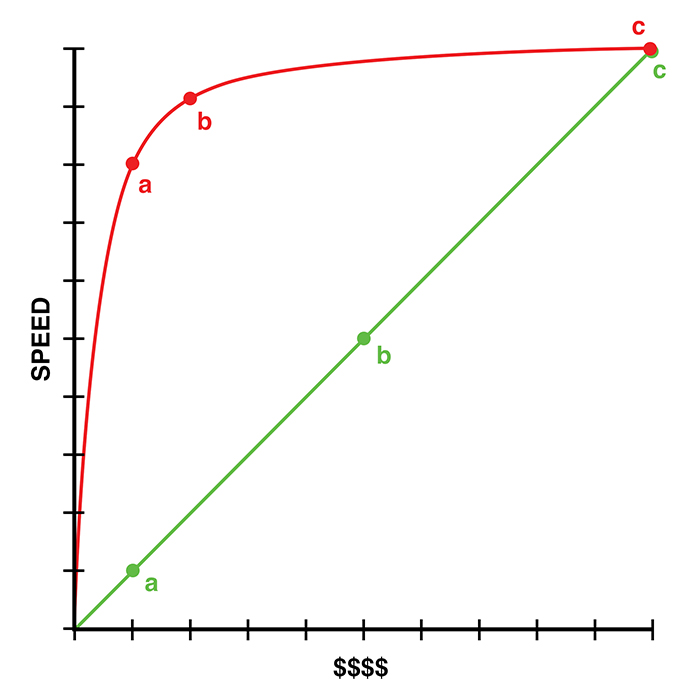
Honestly, I don’t know enough about the sport of motorcycle racing to fact check him, but the figures he recited surprised us. Both Teri and I had assumed that the progression from amateur to professional would be more linear, like the green line on the graph. We assumed that 10% of the cost would give you 10% of the speed, 50% of the cost would give you 50% of the speed, etc. That is, a set amount of effort would result in an equal amount of yield.
It was only later that I realized his progression of speed/cost ($5k, $25k, $100k) was pretty similar to what I had noticed in retouching.
As it happens I am an expert in photoshop, with well over 30 years of professional experience. One of the things I can say with some surety is that anyone can retouch. The Photoshop app is somewhat complex, but retouching with it is not rocket science. You don’t have to have an advanced degree in engineering to use it well. The only thing you really need is experience.

My breakdown on retouching goes something like this: (and yes, I am cribbing from Malcom Gladwell here) 100 hours, 1,000 hours, and 10,000 hours. These are the markers I look for to see how good you are. These numbers are not set in stone by any means. Use them only as a rough guide.
100 Hours
Put 100 hours of work into Photoshop and you will know something like 80% of what you need to be a professional retoucher. You obviously won’t know everything, but 100 hours is enough time to be familiar with most of the main tools, and how they work. Assuming an 8 hour work day, and a 5 day work week, then 100 hours comes out to be just short of 2 weeks. So put in 2 solid weeks of hard work in photoshop, and you’re most of the way to being a professional retoucher.
1,000 Hours
Put 1,000 hours of work into Photoshop and you will know something like 90% of what you need to be a retoucher. Assuming the same rate (8 hour day, 5 day work week) 1,000 hours equals 25 weeks, or about half a year of experience. Half a year is a lot. By then you will have learned most of all the little tricks, have developed a good sense of color matching, and will have learned most of what you need for complex tasks like layer stacking and embedding smart objects.
10,000 Hours
Put 10,000 hours of work into photoshop and there will be very little left I can teach you. In fact, I might be looking over your shoulder seeing what tricks I can learn from you. 10,000 hours is a good, solid five years of effort. Without question, this is a professional level. Honestly, you might be just as good in only 2.5 years, but one of the things I like about the 5 year mark is it’s about that point that you stop making most mistakes. You can know all you need to know before then, but it takes about that long to understand your weaknesses enough to compensate for them. At this point you not only know the work, but you are now looking over your process and tweaking it in little ways to generate slightly better outcomes.
Okay, so that’s a rough scale to follow, but this post isn’t about photoshop or motorcycle racing. It’s about how all types of craft follow this same principle. No matter which art you practice, your progression through it will not be linear, but roughly logarithmic. But (and this is the important part) to those around you, your path will appear to be linear.
There’s two parts to that, so let me deconstruct it a little. The logarithmic path is the way we do art. All of us. It doesn’t matter if we are talking painting, poetry, songwriting, silver-smithing, or quilting, The path to being an expert is the same. It takes about 100 hours to get to know what you’re doing, another 1000 to refine your skills to a fairly sharp point, and roughly 10,000 to pretty much discover every mistake. There are reasons for this progression, but I’m not going to go into them at this time. Again, Malcom Gladwell does a decent job of the topic in his book Outliers (though I wouldn’t believe every word he writes), but there is actual research behind the concept. The numbers are not set in stone, but they make a good rule of thumb. If you’re just learning an art, then this gives you a good idea of what to expect.
And to be clear, there are no shortcuts to this either. I know when you start out doing an art that you want to believe that you have some innate ability which will take you to expertise in less time. I know I do this, and have with every craft I’ve practiced. But the simple truth is, there’s no such thing. Everyone who wants to be an expert needs to put in the hours. Period. When we talk about doing things the hard way, this is what we mean. Yes, it’s difficult. Join the club.
(btw, this is good advice. Do join the club. Be involved with other professionals if you’re practicing a craft that pays well. Their wisdom will help you, and you might just shave a handful of hours under their guidance. But most importantly, you will be around people who are closely aligned to you. This is its own kind of balm. I never have to worry about explaining crazy clients to my other retoucher friends. They all get it. We have a shared emotional experience that is impossible to replicate.)
So back to the topic
This algorithmic progression (100, 1000, 10,000) is roughly the shape of our paths as creative people. But to an outsider these paths will look different. Remember how I said my wife and I were surprised at the cost of a motorcycle compared to its relative performance? This is because we all tend to think of things as being linear. That is, we assume the results should equal the effort. I assume this is just a flaw in human reasoning. I’m not sure of its origin or why we are affected this way, but we are. Perhaps we have an inherited sense of justice, and in a just world 20% effort would equal 20% ability. Thankfully the arts do not work this way. Honestly, most of them are too difficult. If we got relatively poor results early on, then we’d give up. I know I would.
So what this means is that when you put in your 100 hours, your friends and neighbors will look at you and see you are 80-90% of the way to becoming an expert. Naturally, they are going to assume you’re almost there. If 100 hours got you to 80%, then all you need is another 20 more hours and you will have nailed it. Makes sense, right! I mean, that is a linear progression.
The thing is, we’ve all seen this or done this. This part is very normal. Someone you know in high school or a neighbor picked up a pencil in art class and at the end of the semester they could seriously draw. Or they picked up the guitar, or they started singing in choir. It doesn’t matter what art or craft, the results are always the same. 100 hours of serious effort yields a huge amount of ability. And it’s naturally easy to assume success will follow.
But ask any expert in their field and you will get an entirely different response. If someone showed up at my door with 100 hours in photoshop and wanted a job, I would laugh. Someone without any experience at all might look at their abilities and think they’re pretty good, but I would see all of their flaws. This is EXACTLY the situation that every creative goes through when doing their art. This is why I recommend that if you want to be an expert in your art or craft, you work to professional standards. My point here is that those wishing to attain success in their creative field will be measured by the experts, not the amateurs. And believe me, they will have something to say about it.
This is why I believe that overnight success is a myth. First of all, because I’ve yet to see someone who suddenly rocketed to fame that didn’t have 5 or more hard years of experience under their belts. But also because I know what it’s like from the other side. Every professional art or craft is littered with experts, women and men who have done their 10,000 hours (or the equivalent) and know what’s what. Do you think they’re going to let some upstart play with the big boys just because they are cute? Do you think they’re going to go easy on someone else, especially after they had to do it the hard way? Not a chance.
The problem is, you don’t see anyone doing all those years in the arts. Our culture is amazingly blind to this work. Movies are especially bad, compressing any real (and thus boring) work into a montage. Team America even has a hilarious song called Montage that makes fun of this phenomenon. Books are not much better, in part because it’s very hard to express the mind-numbing difficulty of putting in that time. It’s literally something you have to do, and it often feels terrible when going through it. Back when I was a musician there was a common trope that everyone needed to “pay their dues” to be any good. This is the closest I’ve seen to the concept of 10,000 hours being codified in reality. Even then it was a long time ago, and every time I saw the “dues paying” concept it was consistently presented as being wrong, or some kind of gatekeeping. The truth is you often don’t know what you don’t know until you learn it. And it’s almost impossible to teach some things short of experience. That’s not gatekeeping, that’s how the creative process works.
So to wrap this all up, we have this tendency to expect the world to behave in a linear fashion, but the practice of learning any art or craft is actually more logarithmic in nature. It is the difference between our perception and this reality that drives so much confusion, and perpetuates the myth of overnight success.
A few caveats. Probably the most important one is you don’t have to be an expert at every craft. It is totally okay to practice a skill and let it remain a minor one. I have maybe 20 hours of sewing in my whole life, and while I can inexpertly repair a few things, and sew a straight line on a machine, I have no interest in being anything more than this. You not only don’t need to be an expert at everything, but sometimes it’s healthy to intentionally NOT be an expert.
And some skills can sneak up on you. Over the Christmas holiday one of my sisters showed up with a whole bunch of cookies, all of them tasty. This was not a skill I’d noticed in her before. But then I got to thinking, If you only cooked 25 hours a year, starting at the age of 20, by the time you reached 60 you’d have put in a LOT of hours. Well over 1000. That’s enough to make anyone pretty good in the kitchen.
The second caveat is that expertise is not a guarantee for success. In a competitive field like acting, or writing, or music, expertise is often the minimal standard. I know more than one expert who put in the hours and then found it hard to find work. It happens. All that to say you can’t assume x hours somehow = success, only that you are proficient. Sometimes proficiency is all we get.