
Another post of unsolicited advice on how to make it in the creative world, from someone who has been in the trenches for a while.
Last week I wrote a post about Failure. In it I talked about the importance of failure, and how you need to embrace your failures in order to become a professional. I made four key points about failure. They are:
You don’t need to aim for failure, it will come on its own.
Try not to make the same mistake twice.
Keep your mistakes to yourself, don’t dump them on others.
Own your mistakes when they happen.
I still stand by all of those, but this post is going to be a little different. It’s more about the nuts and bolts of doing art – the process of being creative – and less about the philosophy of art or about being an artist. You don’t have to be an artist to follow this advice. It pretty much works with every task.
In simple terms, when you do creative work you need to make mistakes.
Now I know this sounds counter to what I wrote last week, so let me explain some.
As I have posted before, in my day job I am a finisher. This means I am given a poster design called a comp (usually done in photoshop). My job is to upscale this comp to the proper resolution, repopulate all the photos with higher resolution images, and finally make all the photos blend well together. Depending on how well the comp has been built my job can be anything from mind-numbingly routine, to extremely difficult.
The difficult ones I always complain about, even though they provide the most creative freedom. There’s something deeply satisfying about turning a really soft, low resolution image into something sharp and high res, but the process is a lot of work, and causes a lot of stress. Sometimes you are literally painting a face into existence from a few stray pixels. The most difficult parts (the eyes and mouths, because they are the parts that the human eye looks at first) are very demanding. Even the most subtlest of changes can affect the entire piece.
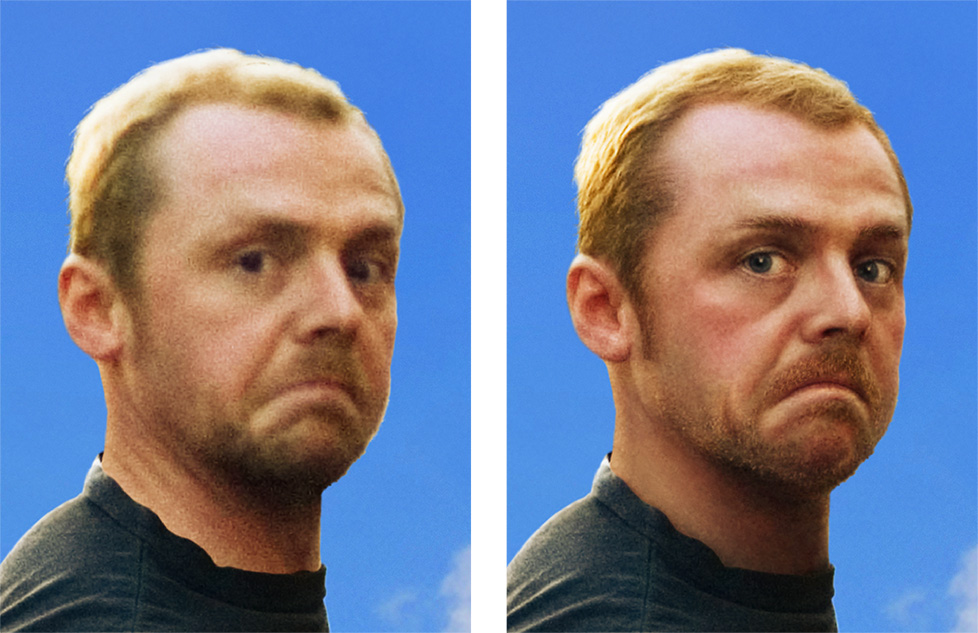
But it’s the easy parts that give me the most grief. The simpler the job (simple meaning less work for me) then the less vested I will be in the final art. Basically, I find it hard to care if I’m not fully engaged. And when I am less engaged I make more mistakes. In very simple terms you could say:
Boredom = Mistakes
At the end of my post on Failure I mentioned that the professionals I respect the most in my field go to great lengths to reduce the chances of making mistakes. This is why. Easy work leads to dumb mistakes.
This is true in every art form. Almost every author will tell you that when the story is really flowing that writing is a joy, but ask that same author what they think about facing copy edits for days on end and you will get a different reply. I know photographers who will jump at the chance to set up their lighting until everything is just right, but then struggle by the 100th shot at keeping the subject in focus.
This isn’t a problem with the creative process, it is a problem with the human brain. Our minds crave novelty, and seek out complexity. If your brain cannot have these things it will start to tune out. And no, it’s not an ADHD thing. It’s a flaw in how our brains are wired. Everyone’s brain does this, not just us skittish and sensitive creative types.
And this is why I say you need to make mistakes. Not to have yet another thing to clean up in your project, but to keep yourself just interested enough that you maintain your focus. You need to make little (and known) mistakes to keep from making large (and unknown) mistakes.
See? Simple. 😉
Here’s where it gets complicated. Only you can tell when your attention is starting to drift, so only you can tell when it’s time to start making mistakes. You have to sense your mood, and keep careful tabs on your mental state. This is by far the hardest part in the process. You have to know yourself well enough to know when things are going wrong. Once you can do that, the rest is easy.
Some examples:
I am blessed because photoshop is such an incredibly flexible app. There are almost an infinite number of ways to fix something. With the exception of resolution and color spaces, almost any solution is a functional one. True, there are some techniques which are better than others, but for the most part you can be creative in the way you fix things. And this part is key. You can intentionally switch things up.
Do you color correct using Curves and Hue/Sat? Try using Levels and Color Balance. Do you draw hair from outside to in? Try going inside to out.
If you’re a musician, try playing a song in a different key or tempo. Play that hard rock song like the deepest of country tunes, and see what that does for you. Switch to a minor key, play it like a polka. Do what it takes to make it new.
If you’re a painter, try painting with a different technique or color. If you’re a writer, try writing in a different voice or style, or have your character do something they would NEVER do.
The point is not what technique you use, it’s what happens to your brain while you’re doing them. Using a normally unused technique will change how you think. I will automatically make your brain focus more, making you more engaged.
Just making the attempt is the important part. It doesn’t even have to be useful. I often try two or three different techniques until I find one that works. The ones that don’t work I throw out. The goal is not just a final technique, but an engaged brain. Don’t be afraid to try and fail two or three times or more. You’re mining engagement here, and sometimes you have to prime the pump to get your brain flowing again.
The trick is to keep your attempts small and constrained. Don’t spend a lot of time thinking about it. Just do it and see what it does. Every mistake should be easy to repair, though I think you’ll be surprised at how many you eventually keep. You don’t want to do something that can spike your project, just something that can nudge your brain into a more focused state.
Besides having less mistakes in your final work, this technique also helps by giving you a more flexible approach to your craft. It is very easy to get all caught up into doing the same process over and over. Sometimes only one procedure will do the job properly, it’s just not always the best thing for your brain.
Basically, you are already creative in your craft, so why not be creative about your techniques as well? Use your creativity to make things better for you, and cause less mistakes.
I think that’s it for this week. Next week I have a technique to make your creative projects more fun.